Happy Thanksgiving everyone! I am still getting settled in my new place, but soon I will be out on the beach and boat finding new things to share on my blog.
For now, enjoy these photos from the public domain. Find them all at the Pixabay site. Each one has a link to the photographer who shared them.
Credit: Wokandapix
Learn about sea glass so you’ll know which colors are most rare and how some people sell it as real, but it’s been hand tumbled.
Credit: HalfpintohoneyCredit: Pixabay
What kind of seashell is this next to the baby? My guess is a Queen Helmet (Cassis madagascariensis), as they can be as big as 12 inches.
One question that arises most often when talking about collecting seashells is, how to clean them. And before we get into that, let me say that I strongly suggest collecting EMPTY, UNOCCUPIED SEASHELLS ONLY. I actually came across an article at a certain site (I will not link to) that tells you how to kill the living animal inside so you can keep the shell. It’s easy enough to find loads of empty seashells. Also, in many areas it’s against the law to collect occupied shells.
Back when the kids were little, when we came home from the beach our pail of shells stayed in the garage for a while. We were busy cleaning off the chairs, cooler and car, so the shells didn’t get cleaned until a later date. I didn’t collect shells to display in my home. They were mostly collected by the kids, and I kept them because that is what moms do – hold onto the children’s treasures. Usually I would put them in the garden outside or in the top of potted plants as decor.
Seashells make good garden accents
But, if you want to display seashells in the house, or use them in crafts or jewelry making, they do need to be washed off at the very least.
How I Clean my Seashells
Now that I live near the beach again, I have often collect shells and have been experimenting with cleaning them. But I’ve found thatthey really don’t need extreme cleaning. Empty seashells (and the key here is unoccupied) will only need a rinsing or two in plain old water to remove the sand. My shells never smell bad. That will happen if there is something dead inside. Don’t collect living shells and you won’t have that problem!
When I found a big, uninhabited horse conch I wanted to see if I could find some pretty colors underneath the blackish coating that was all over it, so I began by soaking it in plain water.
The large horse conch was a true treasure but it was crusted with dried barnacles and black periostracum. I chipped away at the barnacles and scrubbed with a toothbrush. The toothbrush didn’t do much.
That cleaning job was on-going, and I never did get all the black off. It was enough to see the shell beneath which didn’t seem to contain a lot of color anyway. It sits on my kitchen shelf and I think the black coating adds interest.
Florida Horse Conch Seashell
Here is the same shell today, which is a couple years after I brought it home. The periostracum has dried and flaked off somewhat. It is a treasure.
The shell a couple years later
How to Tell if a Shell is Occupied or “Alive”
If the mollusk is still inhabiting the shell you want, you will see a flap covering the opening. If you see claws poking out, it’s probably a hermit crab that is using the once empty shell as it’s home. Even if you see nothing at all, place the shell on the ground, or in the boat (wherever you may be) and wait a bit to see if it “walks away”. Hermit crabs can hide way inside the shell and be difficult to spot. Sometimes they can hide for a long time!
Worn horse conch and two broken knobbed whelks – all have hermit crabs inside!
Living things can also be attached to the outside of the shell. I once found an enormous horse conch that was no longer home to the mollusk that made it, but weird moving things were attached all over the outside. So I took a photo of the shell and put it back in the water.
Empty Horse Conch shell is home for barnacles
If You Do Want to “Clean” the Shells, Here Are Some Tips
Ideas for cleaning your seashells usually include soaking them in some sort of solution. Bleach and water – very small amount of bleach – is the common thinking. Shells that are white, or are supposed to be white can withstand a bit more bleach, or a longer soak. But, after trying the bleach thing a few times recently, I have decided NOT to use bleach. Ammonia is stinky but it will clean them without removing their colors.
I would never use anything but water on delicate things like sand dollars and sea urchins.
To bring out the colors on seashells many people apply some mineral oil once they are cleaned. It could leave them oily, and I prefer a natural look, so I usually don’t use that either.
White shells can be set outside in the sun which will bleach them whiter. Don’t do that with shells that have pretty markings or they will fade. Using bleach, even in tiny amounts, will fade colors too.
So there it is, simple as can be. Rinse your seashell collection in plain old water to remove the sand. Let them dry and display them! Need some ideas on what to do with all those seashells?
My Seashell Collection (part of it!)
If you know of a good way to clean shells, please leave a comment. Happy beachcombing!
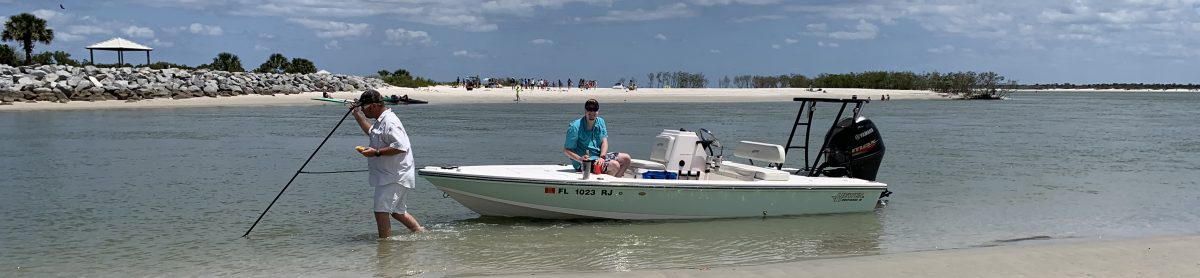
My recent trip to Florida gave me opportunity to do some shelling, or seashell hunting. The Three Sisters Islands are in the backwater area of the intracoastal near Edgewater and that is where we dropped anchor one day. It was hot and we needed to take a dip in the very warm water (80’s at least) to try to cool off. The area around one of the islands was very shallow so I took a walk looking for shells.
The east coast of Florida is not exactly the best place to find shells, and most of the shells I saw were inhabited by hermit crabs. Those things are everywhere! But suddenly I spotted something large in the murky brown water and when I got up close I saw it was a big shell. When I lifted it out, this is what I saw.
The horse conch is the official Florida shell, and I’m pretty sure this is one. I wanted to keep it, and it had no living thing inside, but something attached to it was alive.
Those bumps you can see on the left side in my photo, were squishy and obviously living. I don’t know what they are – maybe some sort of coral? – but I had to put the shell back. So I took my own advice and took some photos and left nature alone.
The only shells I brought back home were collected along New Smyrna Beach, and they are not super impressive. But this horse conch was definitely my favorite find.