When my daughter and her fiancé were visiting we were out boating on the Indian River. This is part of the Intracoastal Waterway along the eastern, central part of Florida.
A big barge passed us by and I got these photos. We never know what we might see while out on the water!
Here’s a little look at what my Zazzle shops are selling during this Christmas buying season. It is here, right? The holiday season has completely snuck up on me. Here in Central Florida the temps are still in the 80’s and most days are hot and muggy even though we are into November. And now…
A chilly boat ride took us to Three Sisters, among other places, where we found interesting shells filled with hermit crabs. Often I have seen tiny horse conchs, and a few times we’ve seen massive horse conchs, but this horse conch was medium size.
Spotted a cool horse conch among the oyster shells
As I waded through the 62 degree water on a 60 degree day, with a wind chill, I came across this pretty little shell. I knew right off that it was a horse conch, but it was larger than the ones I usually find.
Dirty but pretty seashell
This shell had a very large hermit crab inside and he was tucked way down in. I couldn’t keep the shell so I got a few pictures on my iPhone, which I hoped would come out.
Here you can see the pretty lines and bumps which make up the shell, and orange to reddish brown coloring. I’m guessing that this shell was about 5-6 inches long. The snail had died for whatever reason, and a large hermit crab had moved in. Although I previously had read that Hermit crabs do NOT kill mollusks for their shell, this article has opened my eyes to the possibility. However, the crab mentioned lives in farther southern waters.
It is curious as to how hermit crabs just happen to find empty shells the correct size to hold their bodies. In this vast expanse of river, how would that happen? Hermit crabs don’t run around without shells, so how does it all begin?
A few weeks ago when we were out on the river, there were no hermit crabs anywhere, and very few shells at all. It makes me wonder if any of the hermits I see will kill a mollusk / snail and take over the shell for their home.
Smaller horse conch shell with hermit crab inside
The horse conch shell was not in perfect condition and it was encrusted with mud, but it was a beauty just the same. Had it lived, it may have become up to 2 feet long. We have occasionally seen living horse conchs out on the little islands along the Indian River backwaters.
We drove the Hewe’s Redfisher in behind Three Sisters and walked the sandy areas that were showing at low tide. But the water was coming back in, so the sand was disappearing. My son found a starfish / sea star, which I have never come across ever. This one was unfortunately dead and was missing two legs with another one broken. I came across a few gatherings of hermit crabs where it appeared they were checking out each other’s shells. We saw lots of little “baby” mollusks crawling about as well. This area is usually full of interesting wild creatures from the sea, and today did not disappoint.
Pretty horse conch
Various Horse Conchs I’ve Seen on Florida’s East Coast
Found a living horse conch
Two shells and one black cat
Guessing this bleached white horse conch is about 8 inches long.
Horse conch disguised
Baby horse conch shell
Horse Conch
Spotting the old horse conch just offshore
Four hermits in various seashells
Even if the shells can’t be collected, the photos are fun to share. Being educated about what can be found in this wilderness area of Florida is my goal with this blog.
Once we finished up at our first stop (read that post here), we boated up to Three Sisters which is a small group of mangrove islands in the backwater area of the Indian River. The tide was going out, which is my favorite time to beach-comb. We parked in behind the island and I searched for something to photograph.
Once again, as on the first stop of our boating trip, there were no larger shells and no hermit crabs. The tide was low and going out and the water was clear. Without a closer look, this area seemed to contain mud only and a few birds.
View from behind Three Sisters
Clear and cool Indian River water
Bird tracks in the mud
Who made these tracks?
Weird hole
I thought the bird tracks were cool, and the other tracks may have been some kind of crab, but I’m not sure. There were holes in the sand so I suspect that crabs had dug them. I find this low tide landscape interesting, but much more so in the warmer months when living things are everywhere!
What I found was loads of very small sea snails. After finding the sand collar on my first stop, and now loads of “baby” sea snails, I’ve concluded that this is the time of year for babies to hatch. However, I have no idea where all the hermit crabs and larger snails have gone.
One of the little tide pools was teaming with life. All the tiny snails were mostly covered in mud and slowly wandering around. I carefully scooped one into a clam shell I found to take the video above. They looked like little clumps of mud. I cleaned the mud off to get the photo showing the actual tiny shell.
One of many tiny shells / snails I found
Babies or Simply Tiny Sea Snails?
As you can see, the tiny snail below looks different from the one above. Juvenile sea snails are hard for me to identify. All I can go by is what type of gastropods I usually find in this area – horse conchs(according to others it is bright orange as a baby),crown conchs, lightning whelks (opening on the left) and pear whelks. To a much lesser extent I see knobbed whelks, tulip shells, and have a few broken channeled whelks – usually shells only.
Because of the wide dark and light stripes on the shell below, I would guess it’s a baby crown conch. The shell above, no clue. Maybe it’s just a small snail and not a juvenile, but because there were so many tiny shells all together I was thinking that they “hatched” recently. I found no type of egg casing, but that could easily have washed away with the tide. I’m pretty much admitting that I just don’t know!
Tiny striped sea snail – could this juvenile be a crown conch?
Stripes and spikes of the crown conch shell
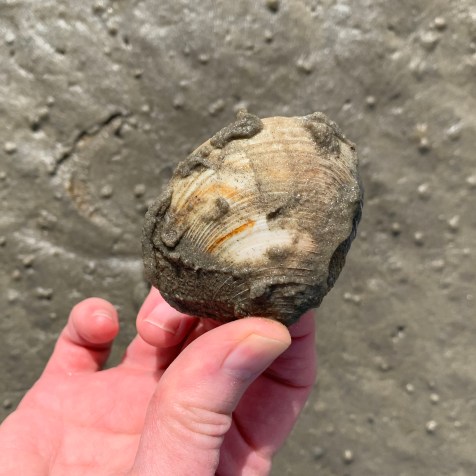
I did find one buried Southern quahog clam shell. I carefully dug at it to see if it was alive, but only one part of the clam was there, so I took it home.
Pretty buried bivalve shell
Southern quahog clam shell
Tagelus shell
All this photo sharing and research on juvenile snails has my brain hurting, so I am signing off for now. What I do know is that these backwater areas look very different (shell-wise) during the winter season.
If you haven’t read the first part of this story, check it out here.