January Boating Along The Indian River Estuary – First Stop

The air temp was in the 70’s and the water in the Indian River was in the 60’s. It was a windy day, so not good for fishing, but we took the boat out for a quick trip.

We stopped at our first spot (second stop link below) and I got out and walked on the mud flats and in some shallow water looking for wildlife. I’ll call this place the Tributary. Water was rushing out fast on the outgoing tide.

The Tributary

We have stopped at this little sandy area many times, but the last time we were here I met my first spider crab. Today it was very quiet and mostly free of living things. Even people / boaters were scarce on this windy day. The usually scurrying crabs were nowhere to be seen and the shells were sparse. I decided to photograph the beautiful mangroves and their crazy roots.

  • Mangroves
  • Mangrove roots
  • Mangrove roots and oysters in mud
  • Mangrove roots and a single clam shell

One thing that struck me was the lack of hermit crabs. There were none that I saw! Usually it is all I see, but today I saw no big shells and no scurrying hermits. I did see a few shells that seemed to be empty, but they may have had hermit crabs.

It reminds me that I have a lot to learn about my local environment.

And then I found an egg casing called a sand collar.

Moon Snails Make Sand Collar Egg Casings

I honestly was not sure what this was, but there were two of these things, so I suspected it was some sort of seashell / sea snail related thing that had to do with eggs. To touch this, you would think it was some discarded piece of trash because it feels like rubber. It is the egg casing of a moon snail (which I usually label a “shark’s eye“).

Sharks eye seashell
Shark’s Eye shell

That collar I am holding is made up of eggs and sand. I didn’t know this when I picked it up, but wanted a photo to identify it on my blog. I had no idea I was holding hundreds of babies! I put it back, and then found another sand collar (link to Wikipedia) nearby to photograph under the water.

Sand collar made up of baby moon snails and sand

The sand collar egg case is laid in such a way so it will stay upright and in place. I wish I had not picked up that first case, but I honestly did not remember what it could be. I should have left it and taken a photo, like I did with the second one. Photography was tough because of the wind and rippling water.

Sand collar under shallow water

The Only Shells I Found Here

As I have mentioned the area was quite different from what I find in summer. There were barely any shells at all of any kind. I took photos of the few shells I did come across. The photo titles are at the bottom of each picture.

  • Broken juvenile horse conch
  • Interesting crown conch shell
  • Pear whelk
  • Ribbed mussel shell

Thanks for reading about our first stop finds. Please go on and read about what I found on our second stop.

About the Spider Crab, Florida Indian River Location

I don’t remember ever coming across a Spider Crab in my trips to the ocean or river (saltwater). I think I would have remembered this big, ugly thing.

While boating the other day, we pulled up to a quiet spot so I could get out and explore the shallows. This is my favorite thing to do. I get to see marine wildlife doing their thing away from the throngs of people.

The tide was high, or else there would be beach areas around this island. The water was still shallow enough to walk the edge in search of cool shells.

Mangroves along the Indian River
Mangroves, tide coming in

It’s not my favorite time to beach hunt for shells, but the water was clear so I walked up along this mangrove island, to the right in the picture above. The water on the left is just a shallow channel that dead ends, I think. The water was in the upper 70’s as I recall, so very comfortable.

I saw the normal crown conchs, pear whelks, lightning whelk, shark’s eye, and of course hermit crabs. In fact, I found a wide variety of sea life in this one area. More about that later. But as I slowly strolled through the shallow water, I spotted something crawling toward me!

Spider crab in Florida
Here he comes

Most everything I encounter while walking these shallows either ducks into it’s shell and hides, or scurries away. The exception is living mollusks which don’t do anything, but close up their shell. Once, a stingray didn’t seem to mind me, and that was scary. My encounter with the Spider Crab was different. This thing was walking straight at me!

Spider crab
What do you see? Crab or spider?

He ended up walking past me up into the mangrove area. He seemed to be oblivious to the fact there was a human nearby.

Spider Crab Fun Facts

Now when I began searching for “spider crab” facts online, I realized there is a crazy big Japanese spider crab. It’s leg span can be 12 FEET ACROSS! Thank God I didn’t wade into one of those, but luckily I was in Florida and not Japan. This was not my crab. The crab I saw was around ten inches across – and I’m totally guesstimating.

There are a few various types of East Coast North America spider crabs and I can’t identify the one I saw. The Portly (Libinia emarginata) has nine bumps along it’s back. The Longnose (Libinia dubia) has only six bumps. I couldn’t see this guy’s back at all to count any bumps.

What I did notice is that the crab I encountered has only eight legs and all pictures I’ve seen of spider crabs shows ten legs. This crab also appears to have no claws! Usually they would be on the ends of the legs in the front. Was he missing a couple of legs? And were they the legs with the claws?

I do know this:

  • They don’t see well. This would explain the fact that he ignored me.
  • The juvenile crabs add things to their top / back area to disguise themselves. Adults tend to be detrius free. This crab has what looks like a bit of red glass on top, among other stuff. I assume he is a juvenile.
  • It is the only type of crab that can walk forward. Most crabs scurry sideways. Normal crabs are quick. The spider crab took his time.
Mangroves Florida Indian River backwater
This is where I encountered the Spider Crab

I love to explore these offshore areas which are mostly untouched by man, but my photography skills are lacking. Often I get home and look at my photos and wish I had taken more, or looked more closely at what I’d found. Out on the water, with my iPhone, and the bright sun, I can’t really see any of my photos well enough to tell if they are any good.

Truthfully, the spider crab creeped me out. It was too much like a spider for my liking. I didn’t dare get too close. Now that I know about them, I won’t be as frightened if I see one again, but I’m doubtful of that happening. This is the first of it’s kind I have encountered in all my years of Florida beach-combing.

Coincidentally, I was in the process of using some vintage fish and crab images in my online store. So I had to use the spider crab image, which was created by James Ellsworth De Kay, back in the 1800’s.

Indian River Boating Photos From Ponce Inlet

We seldom make the trip up to Ponce Inlet in our boat but the other day (this past summer- 2019) we did. Our usual boating area is farther south around Edgewater and Oak Hill. My son dislikes the trip north as it is slow going with mostly minimum wake zones.

A Trip North on the ICW

As we ride up to Ponce Inlet (see my photos from the beach) from the Edgewater area we pass many beautiful homes and see some amazing boats and yachts. We passed a couple of huge yachts on the waterway, but I didn’t have my phone out. The speed is slow the whole way, and we saw paddle boarders as well. It’s a pretty ride with nice views of how the wealthy live.

Boating north on the Indian River ICW toward Disappearing Island and the Ponce Inlet.
Along the river heading north

At the Inlet

The ocean is behind us, just out the inlet.
Our wake as we ride around the Ponce Inlet area

Even though we don’t own an ocean-going boat, my son wanted to see how rough the inlet was. The water was too choppy so we turned around and came back in by Disappearing Island. In the shot above, the ocean is behind us.

View of Smyrna Dunes Park from our boat
South side of the Inlet, beach and condos near Smyrna Dunes Park

It seemed like the channels were all different in the area, and I know they had been dredging, but we found ourselves in a very shallow area where we had to go slow. The water moves the sand around so even unmarked areas can be shallow and especially at low tide.

Condos in the distance as we boat across a shallow area near Ponce Inlet

Photo above: Heading toward the fishing pier at Smyrna Dunes Park, with condos behind it.

coast guard station
Coast Guard Station, Ponce Inlet, Florida
A very built up area

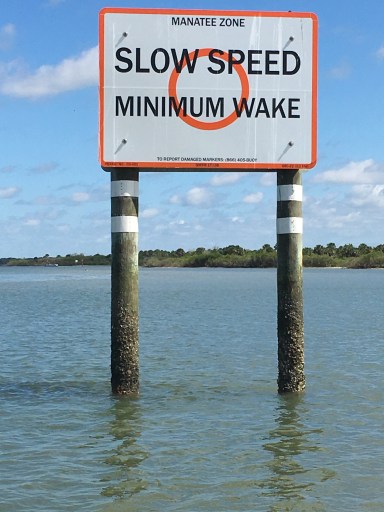
We didn’t see any manatees, but they should be enjoying the warm water this time of year. Boats have to go slow and watch for them. For the most part the manatees stay near the shore and out of the main channel, but we wouldn’t want to hit one. When they are swimming they leave a big bubble-looking wake.

Sign along the waterway

My son will usually drop me at an island so I can explore while he trolls and fishes just offshore. That is when I take most of my photos like the one below with the Ponce Lighthouse in the distance.

Ponce lighthouse beach water
A view of the Lighthouse at Ponce Inlet

My favorite time is when the tide is low or going out. It leaves lots of sandy beaches to explore. No one was on this particular island with us. I believe this beach is part of Disappearing Island, or just south of it.

Ripples in the sand at low tide along an island near the Ponce Inlet in New Smyrna Beach
Outgoing tide leaves a wide beach

Just thought I’d share some riding photos since I usually only share photos from my beach excursions. In this northern area if the ICW (Intracoastal Waterway), just south of Ponce Inlet, the houses are very big and so are the boats / yachts in their front yard.

Nice homes and big boats along the Indian River
Must be nice!

Photos While Boating in the South

Since we mostly stay in the backwaters while we ride, our boating photos are pretty boring. It’s just mangroves and water with the occasional muddy flat. My phone is tucked away in the plastic bag because it’s not waterproof. Even when we see dolphin playing or catch a nice fish I don’t have it handy. Soon I’ll have a new phone which should make things easier.

driving the boat

I get my best photos when I get out of the boat and explore beaches and islands away from all the people.