Second Stop on Our January Boating Trip – Three Sisters

Once we finished up at our first stop (read that post here), we boated up to Three Sisters which is a small group of mangrove islands in the backwater area of the Indian River. The tide was going out, which is my favorite time to beach-comb. We parked in behind the island and I searched for something to photograph.

Once again, as on the first stop of our boating trip, there were no larger shells and no hermit crabs. The tide was low and going out and the water was clear. Without a closer look, this area seemed to contain mud only and a few birds.

  • Three sisters island
  • Clear water in January along the Indian River
  • Bird tracks in the mud
  • Mud tracks
  • Weird hole in the sand

I thought the bird tracks were cool, and the other tracks may have been some kind of crab, but I’m not sure. There were holes in the sand so I suspect that crabs had dug them. I find this low tide landscape interesting, but much more so in the warmer months when living things are everywhere!

What I found was loads of very small sea snails. After finding the sand collar on my first stop, and now loads of “baby” sea snails, I’ve concluded that this is the time of year for babies to hatch. However, I have no idea where all the hermit crabs and larger snails have gone.

One of the little tide pools was teaming with life. All the tiny snails were mostly covered in mud and slowly wandering around. I carefully scooped one into a clam shell I found to take the video above. They looked like little clumps of mud. I cleaned the mud off to get the photo showing the actual tiny shell.

Lots of tiny shells
One of many tiny shells / snails I found

Babies or Simply Tiny Sea Snails?

As you can see, the tiny snail below looks different from the one above. Juvenile sea snails are hard for me to identify. All I can go by is what type of gastropods I usually find in this area – horse conchs (according to others it is bright orange as a baby), crown conchs, lightning whelks (opening on the left) and pear whelks. To a much lesser extent I see knobbed whelks, tulip shells, and have a few broken channeled whelks – usually shells only.

Because of the wide dark and light stripes on the shell below, I would guess it’s a baby crown conch. The shell above, no clue. Maybe it’s just a small snail and not a juvenile, but because there were so many tiny shells all together I was thinking that they “hatched” recently. I found no type of egg casing, but that could easily have washed away with the tide. I’m pretty much admitting that I just don’t know!

Tiny sea snail with striped shell
Tiny striped sea snail – could this juvenile be a crown conch?
crown conch
Stripes and spikes of the crown conch shell

I did find one buried Southern quahog clam shell. I carefully dug at it to see if it was alive, but only one part of the clam was there, so I took it home.

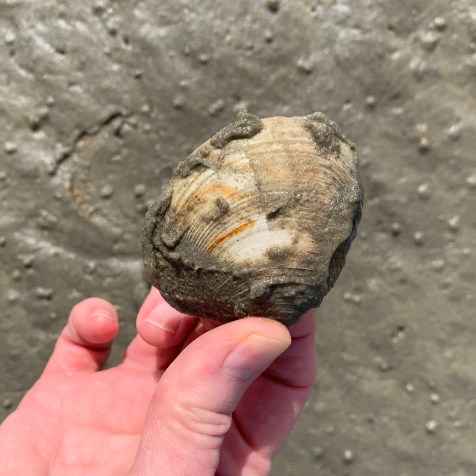
Buried seashell
Pretty buried bivalve shell
Clam shell dug out of the mud
Southern quahog clam shell
Stout tagelus bivalve shell
Tagelus shell

All this photo sharing and research on juvenile snails has my brain hurting, so I am signing off for now. What I do know is that these backwater areas look very different (shell-wise) during the winter season.

If you haven’t read the first part of this story, check it out here.

A Little Spiral Whelk Shell I Can’t Identify

I came across this little shell a few years ago while walking the flats at low tide on the Indian River. A hermit crab was inside, which is the norm for this area, so I took a few quick (and not very good) photos and moved on. But it did not match the usual selection of shells I see in this area.

Light gray little seashell

The shell was small, so possibly a juvenile, and young mollusk shells can look very different from adults. The only clue I have is from a link I found while researching the Channeled Whelk where there is a photo at Mitchell Publications containing shells that look similar to this one. They seem to have the very tightly coiled spiral on top.

My best guess at the time was a Pear Whelk, but it really didn’t have the rounded top. It didn’t look anything like a Crown Conch either, both of which I see often in the area.

Pear whelks
Three pear whelks with two crown conchs in the center

The partial shell below is a Channeled whelk I found not long ago. I rarely see these pretty bumpy topped shells, in fact this one may have been a first. While researching it, I found the shell identification page linked above, and saw the shell that looks like my gray one listed as a channeled whelk. To me, the image below does not look like the little gray shell, but if the spire had not begun to protrude, I suppose it’s reasonable to link them as the same type of shell.

little channeled whelk seashells
Pretty channeled whelk

For now at least, my best guess is that the little gray shell is a juvenile channeled whelk. If anyone knows for certain, I’d love to know what you think.

New Photos, Mom and Baby Lightning Whelk Shells

two seashells with openings showing
Gastropods – Dextral and Sinistral

Not too long ago I was going through my seashell collection and came across this little shell again. The one pictured on the right in this picture to the left.

I never knew what it was and then suddenly it hit me – a juvenile lightning whelk! I knew because I finally looked long enough to realize that the opening is on the left side – it’s a sinistral shell! Then I looked at the lines and little bumps forming at the top and when compared to a more mature lightning whelk it’s easy to see that this one is just a baby – called a juvenile lightning whelk.  So I have a mom and baby – but I highly doubt they are really related!!  It’s just kinda cute.

Photo below shows the two together. Sorry but I have to add my blog name because some unscrupulous people like to help themselves to my photos. So all my pictures are uploaded at a very low resolution and they are only good to use like this – for a blog.  Please do not use photos that do not belong to you!  Add Zemanta to your blog – it’s a great photo archive.

I still don’t know what the other shell is in the photo above. Anyone? I think it’s a rock snail.

juvenile and adult lightning whelk seashells
Baby and adult lightning Whelk shells