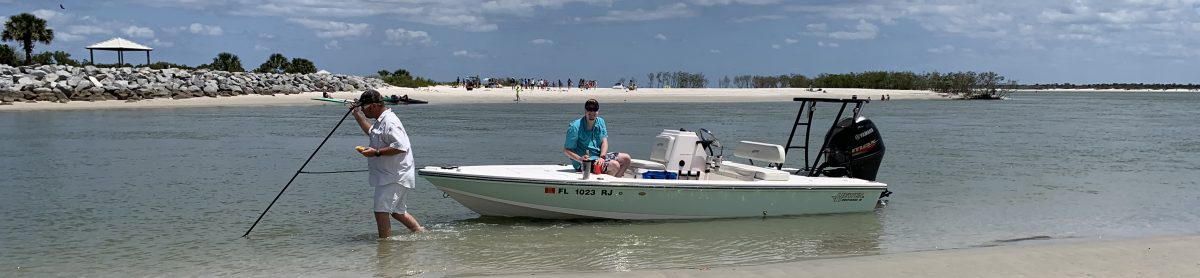
Looking For Shells That Are Out of the Ordinary

Because it is March in Florida, the state is overrun with northern visitors and Snow Birds who are here for a few months. Winter vacation brings in the people seeking sun and warmth in the middle of a frigid northern winter.

Bike Week is just winding down, and events are stopping because of the Corona Virus. It’s now so crowded on the roads that I mostly stay home.

But back in February I ventured over to Smyrna Dunes Park and collected a few shells. I was looking for the types of shells I rarely find, and I did luck out.

New shells for my collection

The walk was invigorating near the water as the temperature was in the low 70’s, and with the sea breeze blowing, it was very comfortable. It was late in the day, but the parking lot was still full. Lots of people take their dogs here.

I walked the boardwalk and then headed down to the sand to search for shells that are out of the ordinary for this area.

Right off I found a big, black ark. This is the place to find black seashells. It wasn’t an unusual shell, but it was nice looking.
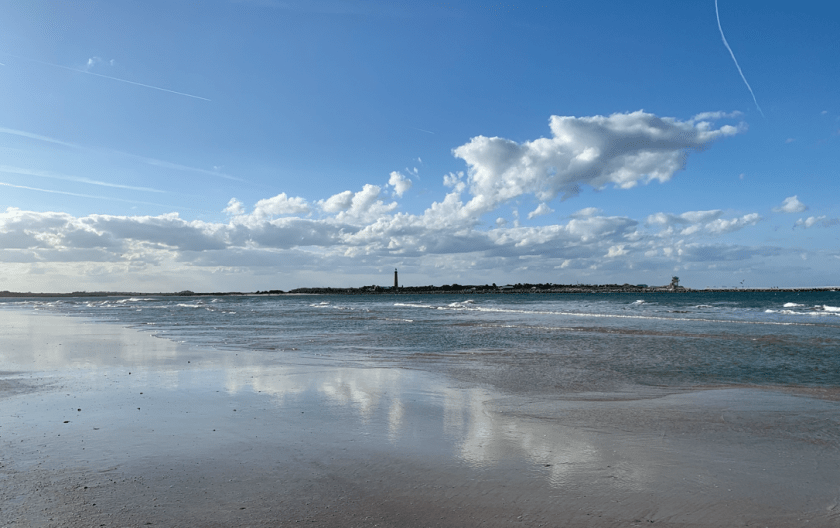
Ponce Inlet New Smyrna Beach Florida
February at Ponce Inlet

As I strolled the shoreline at the inlet and found two golden colored arks with whitish edges. I picked them up. Arks are super common here, but they come in a big variety of colors and can be pretty.

When my son was visiting I found a hairy ark. I assume that is how they look before all that fuzz has been worn off by the waves and sand. I believe this is the periostracum (brown stuff that covers shells) and the clam could be a “bearded ark”, but it’s a guess only.

Ark shell with periostracum covering
Ark shell with periostracum covering making it appear fuzzy

You can see the three arks in my photo below which do not have any brown coating. That is usually how I find them.

The black jingle shell caught my attention because of it’s large size. Jingle shells are not all that common to find around here either. Both black shells are easy to see in the photo below.

seashells black olives
Shells from the Inlet

Then I found my favorite shell, the Dosinia (shell at the bottom on the right in the photo above). As I eyed the sand I saw a flattened shell, and sure enough it was something I wanted.

Other than that, the only other shells I collected were broken bits of Olive shells.

I walked around to the dog beach side of the peninsula and then took the sandy trail leading back to the boardwalk. I’ll share some of my water views and jetty rocks on another post, when I get the photos uploaded.
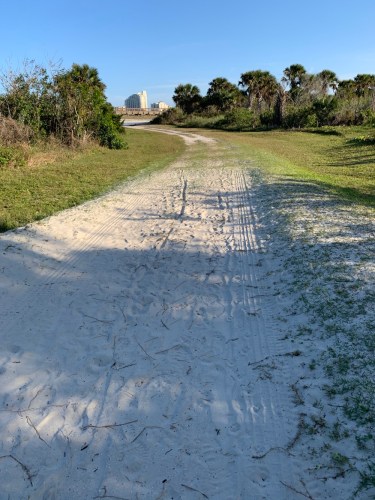
Ponce Inlet dog trail to beach
Sandy path leading in from the dog beach

Shell Inside a Shell, Could it Be a Baby Horse?

crown conch seashell
Tiny Shell Inside Crown Conch

Recently I decided to clean up my seashells.  Honestly, I’ve never made a big production out of cleaning my seashells – just rinsed them well in fresh water and let them dry.  I have collected a few good ones while out on the Gheenoe and the few times I’ve been over to the beach.

Finally I got my Florida driver’s license… which was a bigger ordeal than it needed to be, but it means I can buy a beach pass and get a fishing license. Hallelujah! It’s a little thing, but it means I can go to the beach whenever I want as a resident and pay one low fee for the rest of the year.

Okay, back to the shells. After soaking my seashells in a bleach and water solution – I didn’t measure it, but just added a little bleach to a pail full of water – over night, they are looking clean. They also look a bit duller.   (Actually, I changed the way I clean seashells.)

tiny seashell
Identifying the Little Shell

I have two pretty crown conchs, which are hard to find without a hermit crab living inside, and one had a tiny shell wedged in the opening. I was trying to figure out what type of shell the tiny one was, when I decided to take it out for a better look.

tiny broken horse conch seashell
Baby horse conch ?

My best guess is that it’s a broken horse conch. The Florida horse conch has a long spire like this little guy, but the tiny shell is missing the bottom half. In fact I have a large horse conch shell which I found out on the Indian River which I am in the process of cleaning. I don’t know if I will ever get all the black stuff off it, but I’m trying.

Latest from the Blog

What Is Selling in My Shops During The Christmas Buying Season

Here’s a little look at what my Zazzle shops are selling during this Christmas buying season. It is here, right? The holiday season has completely snuck up on me. Here in Central Florida the temps are still in the 80’s and most days are hot and muggy even though we are into November. And now…

The Jewel Box Seashells Are Leafy, Spiny and Corrugated

Florida spiny jewelboxes
Florida’s Spiny Jewelbox

This is a picture of my spiny jewelbox seashells. I don’t have many and they are simply call Spiny Jewelbox (Arcinella cornuta). They are white with spikes or ridges (if the spikes have worn down) and the inside is pinkish.  These are found on both Florida coasts, but mainly along the Gulf Coast and Keyes area.  Many may not have spines because they get broken and worn off by the action of the sea.

This shell is a bi-valve, which means it comes in two parts.  It is rare to find any bi-valves that are still attached along the beach because the action of the waves tends to break the shells apart.  Also, some bi-valves live attached to something, like wharf pilings or rocks, and that part stays put as the upper half may break off.  This is the case when you find a kittenpaw shell.

Other types of Jewelbox shells, which I may have collected at some point when I had no idea what I was picking up, look a bit different than mine.  In fact, some do not have spines or spikes, but are still rather bumpy looking. The Leafy Jewelbox (Chama macerophylla) has many flattened, thin ridges (unless they are worn – then they are bumpy) and can be colorful purple and orange or bright yellow.

There is also a Corrugate Jewelbox (or Little Corrugated Jewelbox) which is small, growing only to around one inch in size.   It is a flatter, bumpy shell without such distinct ribs as in the spiny variety.  Both of these can be collected on most Florida coastlines, although you may have to search harder on the east coast where shells are more sparse.  These shells are small, whereas the others can be up to three inches in size.

The Atlantic Left-Handed Jewelbox (Pseudochama radians) is also known as the False Jewelbox and I really don’t know much about that one except that it is found from North Carolina to Brazil.

If you live on the west coast of the U. S., you may find the Clear Jewel Box (Charma arcana) seashell along your coastline.  It looks a lot like the Leafy Jewel Box except that it is not as colorful but may be tinged with pink or orange.

What are the spines and “leafy parts” for?  It helps protect them from other seashell predators who may want to drill into the shell and eat what is inside.  Yup, that’s what they do!