Looking For Shells That Are Out of the Ordinary

Because it is March in Florida, the state is overrun with northern visitors and Snow Birds who are here for a few months. Winter vacation brings in the people seeking sun and warmth in the middle of a frigid northern winter.

Bike Week is just winding down, and events are stopping because of the Corona Virus. It’s now so crowded on the roads that I mostly stay home.

But back in February I ventured over to Smyrna Dunes Park and collected a few shells. I was looking for the types of shells I rarely find, and I did luck out.

New shells for my collection

The walk was invigorating near the water as the temperature was in the low 70’s, and with the sea breeze blowing, it was very comfortable. It was late in the day, but the parking lot was still full. Lots of people take their dogs here.

I walked the boardwalk and then headed down to the sand to search for shells that are out of the ordinary for this area.

Right off I found a big, black ark. This is the place to find black seashells. It wasn’t an unusual shell, but it was nice looking.
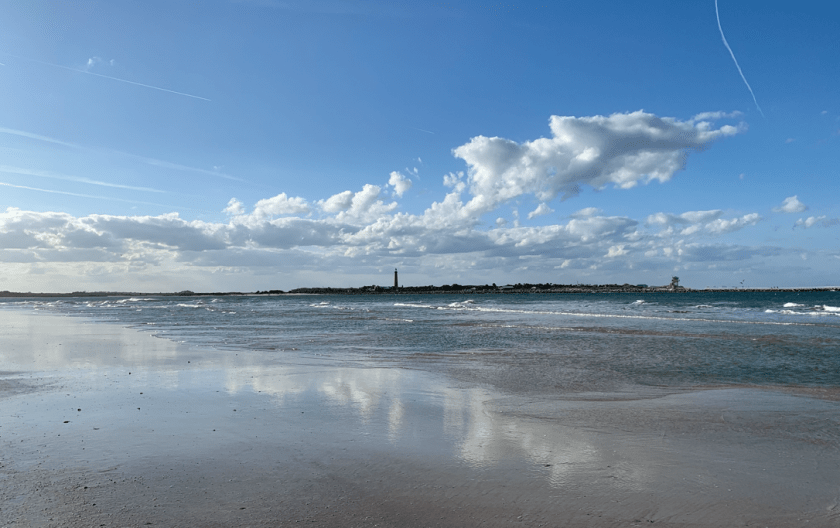
Ponce Inlet New Smyrna Beach Florida
February at Ponce Inlet

As I strolled the shoreline at the inlet and found two golden colored arks with whitish edges. I picked them up. Arks are super common here, but they come in a big variety of colors and can be pretty.

When my son was visiting I found a hairy ark. I assume that is how they look before all that fuzz has been worn off by the waves and sand. I believe this is the periostracum (brown stuff that covers shells) and the clam could be a “bearded ark”, but it’s a guess only.

Ark shell with periostracum covering
Ark shell with periostracum covering making it appear fuzzy

You can see the three arks in my photo below which do not have any brown coating. That is usually how I find them.

The black jingle shell caught my attention because of it’s large size. Jingle shells are not all that common to find around here either. Both black shells are easy to see in the photo below.

seashells black olives
Shells from the Inlet

Then I found my favorite shell, the Dosinia (shell at the bottom on the right in the photo above). As I eyed the sand I saw a flattened shell, and sure enough it was something I wanted.

Other than that, the only other shells I collected were broken bits of Olive shells.

I walked around to the dog beach side of the peninsula and then took the sandy trail leading back to the boardwalk. I’ll share some of my water views and jetty rocks on another post, when I get the photos uploaded.
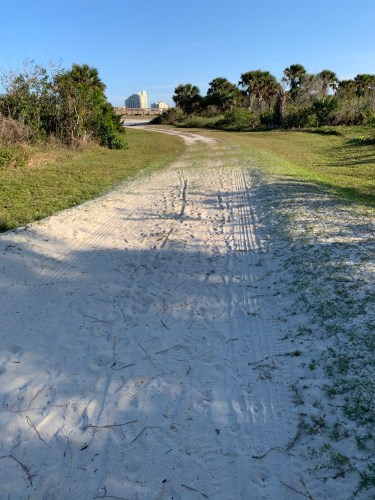
Ponce Inlet dog trail to beach
Sandy path leading in from the dog beach

Ever Wonder About The Reason For Black Seashells?

Ever wonder why you find black seashells? Shells are supposed to be pretty, right? The elements are harsh and shells can turn various colors according to the elements.

Seashells come in many lovely colors, but it’s odd to find shells that are totally black. One day while collecting shells, I found an unusual number of all-black seashells.

Well, it has to do with the mud. I originally wrote this article years ago, after walking the beach at Smyrna Dunes Park and the inlet jetty area. I mostly found black jingle shells as I recall.

Now, I have found a newer article at Shelling Boat Tours that also talks about black seashells. (Thanks Chatgpt) The tour company is located in southwest Florida, a place where everyone seems to want to live – at least over winter. Apparently they encounter black seashells down that way too.

That area of Florida is prone to some big, bad storms. Hurricanes most often only hit me – on the central east coast – AFTER they have come ashore in the Gulf. Mainly the Gulf is calm. It is a nice place for sea snails to live and therefore it’s a great place to do some shelling. Hence the newish industry of taking tourists out on shelling trips.

I agree that the best way to see what is left of the real Florida is to get there by boat. An island full of shells sounds like a fun place to explore, but where I live, I find my shells along the Indian River (in our flats boat) and Ponce Inlet (walking the beach).

Original, to Black, to Orange?

Due to the lack of oxygen when shells get buried, they turn black. That other article says that they turn orange or pink once they are back in an oxygen environment. Being unearthed and washed onshore after a storm is an example of how this could most likely happen. I always wondered about orange and pinkish shells.

In my photo below you can see the black muck that is under this clam shell. Notice that the clam is turning black as well.

Black seashells can be found anywhere really. Tides and storms can move the sand and cover shells pretty easily. After all, what can a sea snail do about that? Or the snail is gone and the shell remains, only to be tossed around, or buried deep down in the muck.

clam shell and black mud


The partial lightning whelk shell below (I think) has also turned black.  These shells do not start out this way.  Lightning whelks are generally tan with brown stripes or light in color.  


Shells are often not pretty when found. Especially if they are found in the water. They can be dark or coated with green, or with barnacles or oysters attached. Sometimes they barely look like a seashell at all, like that partially buried horse conch.

Seashells in True Color

Shells found up on the sand can be white, or much lighter in color than they were when inhabited. Buried shells might be black, and shells that are returning to oxygen may be orange or pink.

In reality, finding a seashell that still has an original pretty coloring might be the rarest find of all!

black seashells among colorful shells

An Outer Coating vs. Ingrained Color

Sometimes out in the wild a living shell, or shell still under the water, will be covered in a dark, sometimes fuzzy, coating. That is the periostracum, or skin, which creates an outer layer over the shell. The pretty part is hidden under the skin. When the skin comes off, the shell looks as we expect a shell to look.

It is completely different from finding a truly black shell. You can see what is left of the periostracum on the horse conch and Dosinia shells below. The shell in the middle has a fuzzy or spiky skin.

After writing this post, I realize that the makers of the shells – the snails – have a pretty tough life. They create a beautiful, and perfect, home for themselves (the shell) but they are at the whim of the elements. The wind, sand, and mud can do some damage and really change things.

Read more about my shelling adventures here:

The Mermaid’s Toenails Turned Black

Screen Shot 2017-04-14 at 9.56.28 AMThe common jingle shell (Anomia ephippium) is easy to identify, but maybe not from a distance.  While walking along the shoreline, spotting a black shell could mean you’ve found just about anything.  Any shell can end up turning dark gray or black in color if the conditions are right.

On my latest visit to the beach, I gathered some jingle shells, of which most were black, as you can see in my photo. One is somewhat silver, and another has bits of lighter tan, which means it still retains some of it’s original color.

But jingle shells don’t start out as black.  Just like the lightning whelk below, shells turn black because of sea and sand conditions.  According to a comment left on another blog, The Ocracoke Island Journal, shells that have been washed into a low oxygen area will turn black due to the presence of iron sulfide.  Click the link to see photos of an impressive collection of shells that were washed up on the beach after Hurricane Irene, many of which are black in color.  Scroll down the page to read the comment about black seashells.

Jingle shells can be orange, yellow, white or off white, and gray.   Because of the coloring and their flat shiny surface they are sometimes called “Mermaid’s toenails”.   Once you hold a jingle shell, the difference between it and other shells is readily apparent.  It’s a bivalve, but there is nothing to suggest it was attached to anther piece.  The shell is irregular and somewhat flattened.  They are rarely over 2 inches across in size.

In fact I did collect quite a few black shells that day. I’m not really sure what that black one is in the photo below. It was too thick to be a jingle shell, but had the right shape.

cross-barred venus clam
One of the black shells I found

This piece of a whelk and the pointed bit of shell caught my eye also because of the unusual dark color.  I have decided it is a Lightning Whelk.  It is my best guess as the other side looks like the opening would be on the left.

I don’t think it’s rare to find a black seashell, but the shell was washed up from a place that had the right conditions to turn it into this, from it’s natural beautiful state.

black seashell
Black Lightning Whelk

Lightning Whelk
Lightning Whelk