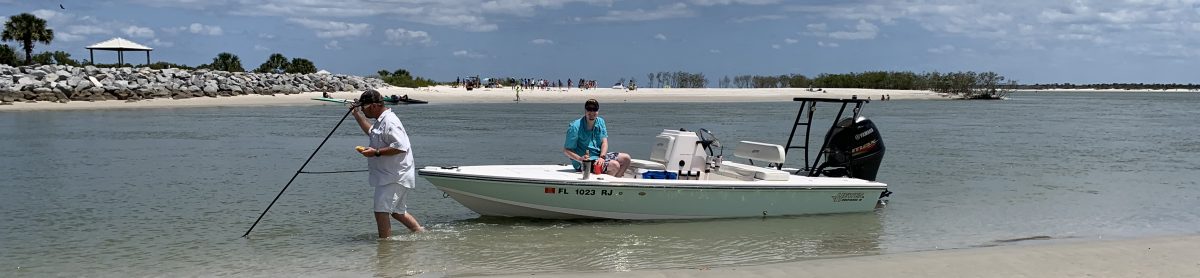
My son is a creature of habit and whenever we go boating we usually end up in the same places. However, the other day we stopped the boat at a new little island which was off the beaten path. The tide was going out so the beach area got bigger and bigger as the day went on, and I discovered many treasures to photograph.
As is always the case, there were many seashells inhabited by hermit crabs of all sizes. This island also contained lots of living mollusks in comparison to what I usually see.
Some hermit crabs tip their shells up like this crown conch shell in the sand.
Sometimes hermit crabs will be buried down under the sand inside a shell. Other times they are gathered in clumps just under the water. And recently I’ve noticed that some hermits tip the shell up, like the crown conch in my photo above. I did see lots of hermits, but I’ll save that for another post.
A Promising View From the Boat
As soon as we docked the boat, I could see shells scattered across the sand and two large whitish shells in the water. They turned out to be a Quahog clam and Elegant dosinia. Further down the beach I found a whole, live quahog clam which was big! I usually find these shells already broken open so finding that whole clam was a treat.
The side of the clam that had been sitting in the mud was turning black. I’ve written a post about why seashells turn black. The Dosinia nearly fooled me as I thought it was the other half of the clam – it was so large. Then I found another just under the water. These are the only two shells I brought home with me.
Dosina & Quahog Clam
Two Dosinia Clam Shells
clam inside
More Random and Interesting Shells Found on the Island
This Shark’s Eye had some nice coloring with a very blue “eye”. A hermit crab was inside.
This lightning whelk was a beautiful and unique pink color with a gray top.
Pinkish lightning whelk
This little muddy island was home to many tulips, both banded and true varieties. They were stunning shells in the most gorgeous colors, and always home to a hermit crab.
In the photo below two hermit crabs meet up. One has a crown conch for a home and the other owns a banded tulip shell.
I will be writing a whole page about the beautiful tulip shells I saw on this island. Later in the day we stopped at Three Sisters where I found more awesome wildlife. The following day we did some boating near Ponce Inlet which is also a place to find islands to explore. Those islands are made of hard packed sand without the variety of shells and wildlife, but they are beautiful in other ways.
Once I get home and begin to go through my photos I always wish I’d paid closer attention to each shell. I’m getting into the habit of taking more photos, but it’s hard to tell out on the water how they look. I need to be better about conveying sizes. I’ve packed a pencil to use next time I get photos.
The shell-makers are the mollusks, or sea snails, which begin life as tiny creatures who will make stunning and intricate homes we call shells. The shell thieves are the hermit crabs who take over the shells once the mollusk has died and left it empty. Let’s be clear, they have to steal these shells to survive, and they don’t kill the owner, just move in once it’s no longer occupied.
Of all the shells I find on my Florida boating and beach-combing journeys, 99% of the gastropods (shells in one piece, not two) are filled with one of these; mollusks / sea snails, or hermit crabs. Rarely do I find a pretty spiral shell which is empty.
Let’s Take a Boat Ride and Find Some Wild Florida Things
Once we launch our flats boat, we head out across the main channel of the Intracoastal Waterway (Indian River where I live) and enter the back channel. The waterway we travel is not as deep, but it is large with numerous islands and shallow canals. It would be very easy to become lost, or turned around in this area. My son has been fishing here for many years so he knows where to go and how to follow the deeper water while running the boat. The water is murky as you can see in my photos, and it is saltwater. On this day in May the water temperature was around 85 degrees. Very warm! We saw many dolphin, but no manatee.
Shallow backwater where islands of mangroves and oyster beds thrive in brackish water
We pull up at a canal which is emptying into the larger canal as the tide is being pulled out (photo below). Tides are weird way back here because the water has a long way to go to meet the ocean up atPonce Inlet. The water can move fast in places depending on what the tides are doing.
In the photo below the water is rushing toward me. The tide is going out. The greenery you see are mangroves. The bottom is sandy and the water is shallow – about to my knees. (There is an excellent article about Florida mangroves at the FDEP (Florida Department of Environmental Protection.)
A more shallow canal emptying water out as the tide changes
To the right of the photo above I see grass and a sandy bottom just below the water. Soon the sand will dry out while the tide is low. This is where life abounds.
The shell-makers and shell thieves live in the same places as far as I can tell, and they love the mangroves. The conchs and whelks can probably find food in this ecosystem and the hermits can find empty shells. There were no birds here, but we usually do see herons or other birds (sometimes the Roseate Spoonbill) along the edge of the mangroves.
We beach the boat in shallow water here and I get out to find sea life to photograph. I expect to find lots of hermit crabs and I do. One is poised at the top of a stalk (below). Others inhabit whelks and conchs (lots of crown conchs) and they all scurry around doing their thing. Sometimes I find groups of hermits together and I don’t know what they are doing except maybe inspecting each other’s shell size. I’m not a scientist, but I know they need to upgrade to bigger shells as they grow.
This little hermit crab has climbed a stalk in the shallow water
As I begin my walk I immediately see three different shells at my feet. A pear whelk (bottom of photo), big tulip, and crown conch are all scurrying. The sea snails move slowly, but the hermit crabs, which now live in the shells, are quick. I can see their spidery legs pulling the shells along the sand.
Three different shells each inhabited by a hermit crab
Those two shells at the top, in my photo above, meet up and the bigger one seems to be bullying the smaller and pulling at the shell. I plan to do some research on our local hermit crab population and write a post all about it. I most often see the Striped hermit, like the one in my photo. One time I found a Giant red hermit crab and that was awesome! Right now, I don’t know much about the activity of hermit crabs but I often find clumps of them together.
The hermits meet up
I’m always amazed at the various sizes of hermits I find in the wild. The one inside this little shell is very small. I wanted a photo of the shell to maybe identify it, but I don’t know yet what it is.
Little shell of some sort with a tiny crab inside
Below is a photo of a haven for sea life. In this murky water, which is at the base of the mangrove tree roots, are oysters, small fish, hermit crabs and quite possibly live sea snails.
There are many living creatures under this murky water
A little further along and I found higher ground where the red mangrove roots could be seen. At high tide the roots are mostly covered by water. See the oysters attached along the base of the red roots? Oysters are important for filtering the water. We have to be careful not to hit any oyster beds with our boat, and it’s one of the reasons I wear water shoes. Oysters can easily cut feet!
Oysters cling to mangrove roots
As I walked along, blue crabs scurried out of my way, or ducked into holes in the sand to hide.
A blue crab scurries out of a hole in the sand
I saw small fish, but larger fish use these mangrove areas to have their young and find food. Fiddler crabs were abundant on this island and another island we visited which was closer to the Inlet up north.
All those little brown things are tiny Fiddler crabs scurrying into the shadows as I walk by! There had to have been millions on this island…! Fiddler crabs are a favorite food of Sheepshead fish. Other fish probably eat them too.
A gazillion fiddler crabs scurrying off into the mangroves
The Best Part of Florida
In my opinion the best part of Florida is where there are few to no people. The mangroves and backwaters, during the weekdays, are peaceful and quiet. It’s like going back in time to the way Florida was before the invasion of people. I imagine this is how it looked to the Indians and explorers. But I think the wildlife was much more abundant when they were here.
Then I catch a glimpse of the high-rise condos along the Eastern horizon and it’s back to reality. I fear for this area because my biggest problem with Florida is it’s seeming lack of consideration for natural habitats. I can’t help but wonder if years from now no one will get to see what I’ve seen today.
Why is it a problem for you to let your dog run off-leash in a campground? Or on trails near the campground? Read this post if you think it’s okay for dogs to do this.