

The bivalve seashells, or shells that come in two parts or halves, can be similar in appearance, but not all bivalves are clams or scallops.
I’ve gathered some photos of the more common bivalves I see on beaches and in the saltwater rivers around my area of Florida. A general bivalve list includes: clams, oysters, scallops, cockles and mussels.
The water that surrounds Florida provides sea snails with the perfect environments for life. Crashing waves are not friendly to shells, so many of the most beautiful shells are found on the Gulf coast. Most often the shells I find on the east coast are along the muddy saltwater riverbeds. This includes the calmer waters just inside the ocean inlet.
Table of Contents
Clams and Arks
My photos below in this section contain various types of clam shells. Also, there are many types of Venus clams and loads of coquina clams. Shells called Arks are also clams.
Clam shells can be hefty and large, or thin and fragile. The Angelwing shell and Channeled duck clam are often found broken. They tend to break up in rough surf. Dosinia clams are smooth and thin, but strong. They are one of my most favorite seashell to find.


Oysters
I rarely collect oyster shells but we see oyster beds while out on our boat. Oyster shells are sharp, and are the scourge of boaters because they can slice up the underside of the boat. But oysters are needed to keep oceans and rivers clean.
Oysters filter the water, and they grow in clumps that give sea snails, crabs and fish a place to hide and live. While walking the flats in oyster areas I can hear the shells snapping. You can read more about oysters at OneEarth.org.


Scallops – Bivalves With Color
Scallop shells can be some of the prettiest shells. Certain types of scallops have one flat side and the other is normal / rounded. The concave part is in the sand or bottom and the flat part is on top and opens like a flap when the scallop is alive. Scallops propel themselves around by opening and closing their shells.
The Kitten Paw and larger Lion’s Paw (don’t have) shells are also scallops. I found these Kitten Paw shells while visiting Sanibel Island on the Gulf coast. I’ve never seen any where I live on the east coast.


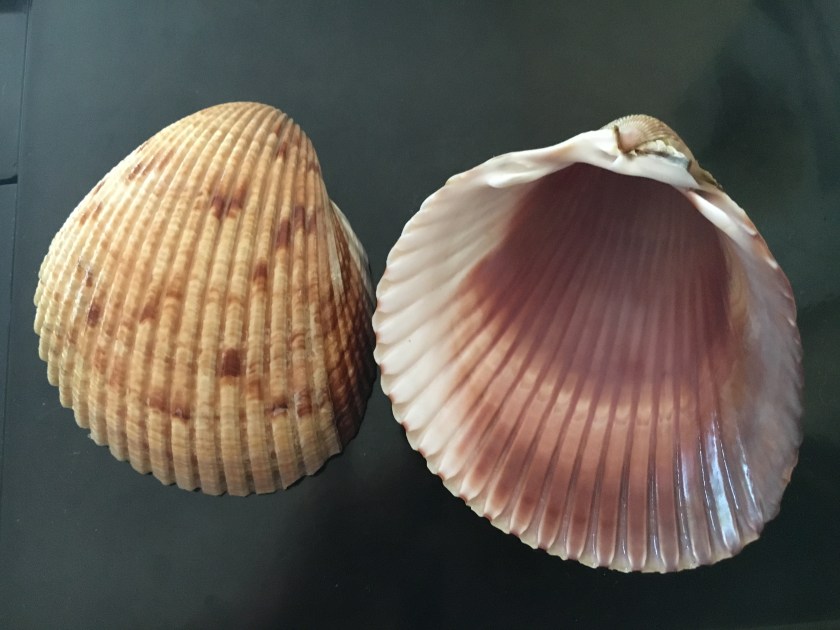
Cockles – Bivalves With Color Inside
Cockles are not clams although they look similar. Because they have an oval shape with high top part (umbo), when a whole cockle is viewed from the side it resembles a heart. For that reason, they are known as the heart shell or heart cockle.
Most often these bivalve shells are often found open and partially buried in the mud. Even if the two halves are attached, usually as they dry out they will come apart.



Mussels
Mussel shells are something I rarely collect or photograph because they really are not great looking shells. The pen shell is distantly related and I have a few pictures here. The pen shell can be nearly a foot in length and is more impressive than a mussel. Read a lot more about Pen shells at the Sanibel Captiva site.


More about the shells

Big Seashells Found in Florida
Sharing some photos of the big seashells I’ve discovered while beach-combing along the Indian River.

Pretty Gray Banded Tulip Shell
A quick little share of this pretty gray banded tulip shell found on a recent boating trip. Read more shelling stories…

Shells Found on a Deserted Beach
Found lots of knobbed whelks on this deserted island beach in Mosquito Lagoon. And a few other pretty shells.

Collecting Seashells: Grouping the Bivalves
The bivalve seashells, or shells that come in two parts or halves, can be similar in appearance, but not all bivalves…

Scallop Shells Collected on the East Coast
While photographing my newly collected shells the other day, I decided to re-photograph my pretty scallop shells. Florida waters can contain…

A Rare Find For Me, The Bubble Shell
The bubble shell is immediately recognizable by the wide open curl at the bottom of the aperture. The shell I found…


