Collecting Seashells: Grouping the Bivalves

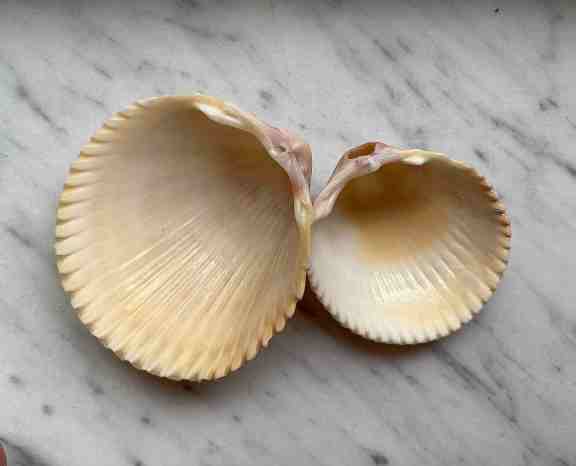
The bivalve seashells, or shells that come in two parts or halves, can be similar in appearance, but not all bivalves are “clams”. I’m not scientifically minded, but I’ve been learning the difference between the shells I collect and photograph.

I’ve gathered some photos of the more common bivalves I see on beaches and in the saltwater rivers around my area of Florida. A general bivalve list includes: clams, oysters, scallops, cockles and mussels.

Clams and Arks

My photos below in this section contain various types of clam shells. Also, there are many types of Venus clams and loads of coquina clams. Shells called “arks” are also clams.

Oysters

I rarely collect oyster shells but we see oyster beds while out on our boat. Oyster shells are sharp, and are the scourge of boaters because they can slice up the underside if a bed is accidentally hit while running. While walking the flats in oyster areas I can hear the shells snapping as they feed.

Scallops

Scallop shells can be some of the prettiest shells. Certain types of scallops have one flat side and the other is normal / rounded. The concave part is in the sand or bottom and the flat part is on top and opens like a flap when the scallop is alive. Scallops propel themselves around by opening and closing their shells.

The Kitten Paw and larger Lion’s Paw shells are also scallops. I found these Kitten Paw shells while visiting Sanibel Island on the Gulf coast. I’ve never seen any where I live on the east coast.

Cockles

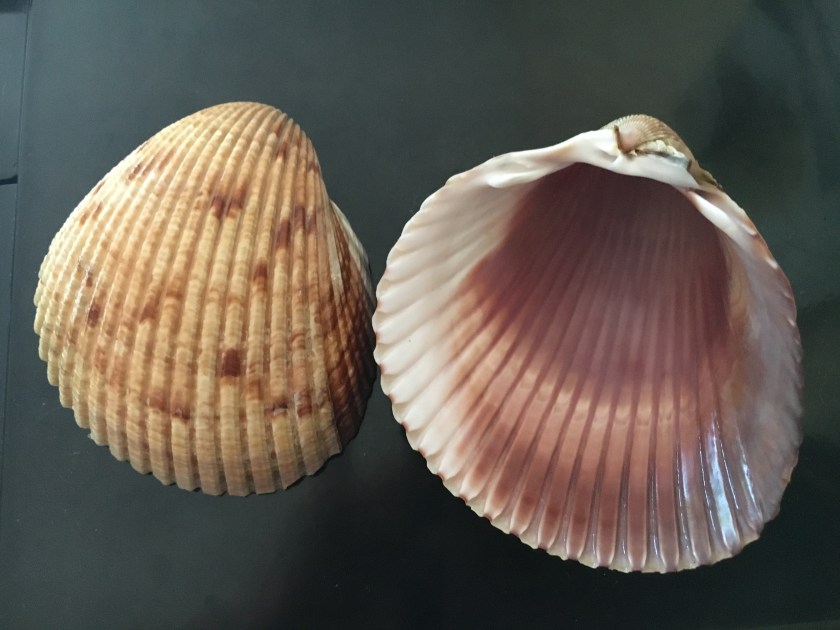
Cockles are not clams although they look similar. Because they have an oval shape with high top part (umbo), when a whole cockle is viewed from the side it resembles a heart. For that reason, they are known as the heart shell or heart cockle.

Mussels

Mussel shells are something I rarely collect or photograph because they really are not great looking shells. They are dark colored and shaped like thin fans. The pen shell is distantly related and I have a few pictures here. The pen shell can be nearly a foot in length and is more impressive than a mussel.

Keep Reading! … Newest Posts on This Blog

Back to Gamble Rogers For a Quick October Camping Trip
We took a quick camping trip to Gamble Rogers on the east …
Our Camping Trip to Silver Springs
Our first trip to stay at Silver Springs Campground was a lot …

Identifying and Comparing the Cockle Shells

This quest began when I found two pretty, yellowish seashells on a recent beach-combing trip to Ponce Inlet.

yellow prickly cockles and gray shark’s eye shell
Shark’s eye and prickly cockle
yellow pricklycockle gray shell spiral
Yellow prickly cockle and graying whelk spiral

They are shaped a bit like scallops and / or arks but they contain bumps around the sides and bottom of their shells. I knew they were not scallops.

Both new shells (top two in the photo below) were yellow underneath. I also noticed that they had distinct ridges where the shells would have connected. When I looked up these beautiful shells in my identification book, I found that they are both Yellow Pricklycockles.

scallop shells, dosinia, pricklycockles
Top – 2 Pricklycockles, Bottom – 3 scallops

The Yellow Pricklycockle

These shells are a unqiue and rare find for me, but they are not rare shells. According to my reference book, they can be found on beaches all around the state of Florida. Because they look similar to most of the beach bivalves I see, I may very well have passed them over in my beach-combing travels. After all, those ridges would be easy to miss. And the shells I find are not always in great condition.

In the photo below I tried to get a better shot of the ridges on this shell. There are two other types of pricklycockle mentioned in my Seashell ID book and are the “Even” and “Florida” pricklycockle. This yellow type grows to a max of 2.5 inches.

This Shell Got a Brush Cleaning

As I dug through my shells, looking for more cockle shells, I came across this rather ugly, but rough shell. It was a pricklycockle alright, but it was caked with sand and had been hiding in the bottom of my shell dish.

I began to photograph it and decided it really needed a cleaning. Usually I clean off my shells when I get home, but this one somehow got put away dirty. So, I brushed the mud off with a stiff brush and the yellow began to show up!

This is the same shell as in the six photos above! It cleaned up nicely. To my knowledge I now have a total of three yellow pricklycockle shells.

The Atlantic Giant Cockle

Sometimes the underside of bivalves can give better clues as to what type of shell I’m looking at. Often they can look very much alike on the outside.

I noticed that the yellow pricklycockles have distinct protrusions up at the top where the shells attach. When I flipped over the Giant Atlantic cockles in my collection, they had the same unique feature. They are also cockles.

underside of the giant Atlantic cockle shell
The underside of the Atlantic cockle
yellow pricklycockles
See the underside similarities in the cockle shells

I see the big Atlantic cockles quite often and they are usually quite large. Often they are open in the sand where they have most likely been dropped by a predatory shore bird. Usually they are tan in color with splotches of darker brown. The underside can be brown-purple to pretty pink. I always thought they were some kind of clam. Cockles are not clams.

large cockle shells
Giant Atlantic cockles and yellow pricklycockles

I don’t color my photographs when I get them ready to share on this blog. The colors you see here are very close to actual shell colors.

Once I noticed the similarities, I began to dig through my shell collection to see if I had any more unidentified cockles. Turn your bivalves over and it may help with identification.

Digging Through My Seashell Collection

As I began to search through my seashell collection, I got carried away. I began organizing by piling similar shells together. My next venture is to identify the various arks because many of those look a lot alike. I also found a few one-of-a-kind shells which means I rarely find them where I live.

seashell collection
Digging through my collection of shells
yellow pricklycockle shell
The Pricklycockle is the newest addition to my collection

Cockle Shells and Ark Shells

The cockle shell is easy to confuse with the ark shell. Arks are the ones you are most likely to find along Florida’s east coast beaches. Both types live in the sand near beaches, so it figures that their empty shells would be washed up on shore once the mollusk dies.

Arks are fairly small in comparison to the Atlantic Giant Cockle, pictured here.  The Giant Cockle can grow to be 5.5 inches.

inside the giant cockle shell
Once cleaned up, the inside of the giant cockle is mauve pink.

The shape of the giant cockle when closed, makes a heart. Therefore, it is also known as the “heart cockle”.
Sorry, my shell is not very pretty, but you can see the heart shape.

heart cockle shell
The giant cockle is also called the “heart cockle”

Ark shells begin white, and can change color. Shells that are brown, rust color, pinkish and yellow, turn that way from long term exposure to the air. Black shells have darkened because of iron sulfide in the sand in which they are buried.

Arks don’t grow as large as the giant cockle, with their max size being around 4.5 inches (the Cut-ribbed ark), but the ones I find are 1-2 inches.  Within the ark population there are various types of arks, which I will get to later on in this blog.  But all arks can be found on all Florida beaches.

ark shells
Ark shells can be colorful

Although I find both types of shell often, the larger cockles are usually spotted away from the area of the crashing waves. I find the big ones, usually still hooked together, out on the flats in the backwater areas at low tide.

cockle shells and arks
Can you find the 3 cockle shells in this photo?

The arks and cockles resemble each other, unless you look closely. Arks tend to curve a bit at the top. Below I have one of each type side-by-side. They are similar in color and size, but it should be apparent that they are not the same type of shell.

cockle shell and ark shell
Cockle on the left, Ark on the right