Cockle Shells and Ark Shells

The cockle shell is easy to confuse with the ark shell. Arks are the ones you are most likely to find along Florida’s east coast beaches. Both types live in the sand near beaches, so it figures that their empty shells would be washed up on shore once the mollusk dies.

Arks are fairly small in comparison to the Atlantic Giant Cockle, pictured here.  The Giant Cockle can grow to be 5.5 inches.
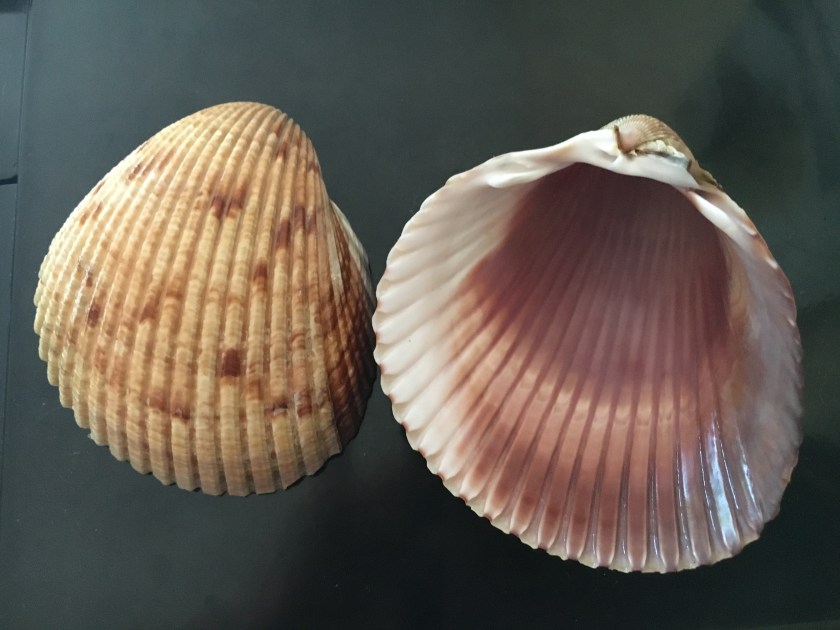
inside the giant cockle shell
Once cleaned up, the inside of the giant cockle is mauve pink.

The shape of the giant cockle when closed, makes a heart. Therefore, it is also known as the “heart cockle”.
Sorry, my shell is not very pretty, but you can see the heart shape.

heart cockle shell
The giant cockle is also called the “heart cockle”

Ark shells begin white, and can change color. Shells that are brown, rust color, pinkish and yellow, turn that way from long term exposure to the air. Black shells have darkened because of iron sulfide in the sand in which they are buried.

Arks don’t grow as large as the giant cockle, with their max size being around 4.5 inches (the Cut-ribbed ark), but the ones I find are 1-2 inches.  Within the ark population there are various types of arks, which I will get to later on in this blog.  But all arks can be found on all Florida beaches.

ark shells
Ark shells can be colorful

Although I find both types of shell often, the larger cockles are usually spotted away from the area of the crashing waves. I find the big ones, usually still hooked together, out on the flats in the backwater areas at low tide.

cockle shells and arks
Can you find the 3 cockle shells in this photo?

The arks and cockles resemble each other, unless you look closely. Arks tend to curve a bit at the top. Below I have one of each type side-by-side. They are similar in color and size, but it should be apparent that they are not the same type of shell.

cockle shell and ark shell
Cockle on the left, Ark on the right

Seashell Identification ~ Coquina

The tiny Coquina shell is found all over the Florida beaches (it’s the small shell in the photo below), but they are usually busy digging themselves back under the sand each time the waves wash over them. They can be found in many pretty colors and I have only one…because they were so numerous and I wasn’t very interested in collecting them. See a nice picture at this link.

Shells in Sand mousepad

Shown here with two Turkey Wing shells, the little coquina shell was used in building material and many structures were built in Florida using it. The famous fort in St. Augustine, Castillo de San Marcos, is an example. Read more about the fort and the coquina used to build it on this page and other structures built totally or partially with coquina rock.

I had a large “rock” of coquina in my yard which I used as a decoration, since Florida is devoid of  “real” rocks – unless they’ve been imported.

Jingle Shells aka Mermaids’ Toenails

Jingle shells (Anomia ephippium) are not hard to find on the beaches of Florida.  They can also be found from Massachusetts to Brazil according to my seashell ID book.

They have been given the nickname “Mermaid’s Toenails” and I can see why.  They are wrinkled and polished looking and come in a variety of translucent colors from shades of orange to dark gray, with white and off-white being common as well.

Jingle shells in pretty peach, yellow, white and silver colors
Jingle shells come in pretty colors.
black and silver jingle shells
Jingle shells which have turned black due to being buried in sediment before eventually washing ashore. Read more about black seashells here.

The “jingle” part of their name comes from the fact that they make a jingling sound when a group of them is collected and shaken around in your pocket or pail.  Their thinness does not mean they are fragile, in fact they are very sturdy little shells that measure around one to two inches across.  The pretty variety of colors makes them perfect for display or creating crafts and they add interest in a jar of shells.

The mollusk that makes the shell usually attaches itself to something – a rock or even another larger shell – in the ocean.   It also takes the form of the item it attaches to which would explain it’s bumpy appearance.   Then, when the bivalve shell splits apart – for whatever reason, only one half washes up on shore.  The other half is still attached to the place where it lived, or breaks since it is the thinner part of the shell.  You will most likely not find a jingle shell in two parts on the beach and the part you do find is probably the left half.


Read Recent Blog Posts