Collecting Seashells: Grouping the Bivalves

The bivalve seashells, or shells that come in two parts or halves, can be similar in appearance, but not all bivalves are “clams”. I’m not scientifically minded, but I’ve been learning the difference between the shells I collect and photograph.

I’ve gathered some photos of the more common bivalves I see on beaches and in the saltwater rivers around my area of Florida. A general bivalve list includes: clams, oysters, scallops, cockles and mussels.

Clams and Arks

My photos below in this section contain various types of clam shells. Also, there are many types of Venus clams and loads of coquina clams. Shells called “arks” are also clams.

Oysters

I rarely collect oyster shells but we see oyster beds while out on our boat. Oyster shells are sharp, and are the scourge of boaters because they can slice up the underside if a bed is accidentally hit while running. While walking the flats in oyster areas I can hear the shells snapping as they feed.

Scallops

Scallop shells can be some of the prettiest shells. Certain types of scallops have one flat side and the other is normal / rounded. The concave part is in the sand or bottom and the flat part is on top and opens like a flap when the scallop is alive. Scallops propel themselves around by opening and closing their shells.

The Kitten Paw and larger Lion’s Paw shells are also scallops. I found these Kitten Paw shells while visiting Sanibel Island on the Gulf coast. I’ve never seen any where I live on the east coast.

Cockles

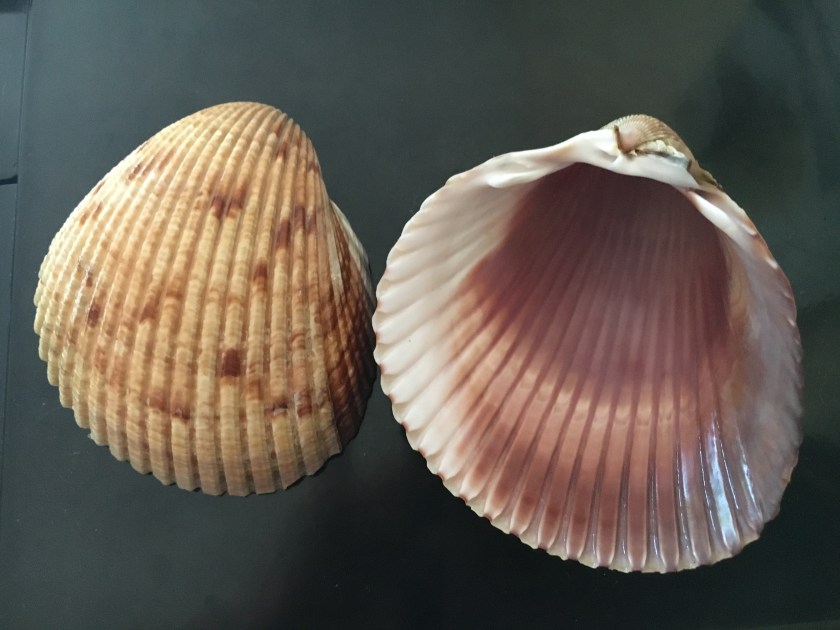
Cockles are not clams although they look similar. Because they have an oval shape with high top part (umbo), when a whole cockle is viewed from the side it resembles a heart. For that reason, they are known as the heart shell or heart cockle.

Mussels

Mussel shells are something I rarely collect or photograph because they really are not great looking shells. They are dark colored and shaped like thin fans. The pen shell is distantly related and I have a few pictures here. The pen shell can be nearly a foot in length and is more impressive than a mussel.

Keep Reading! … Newest Posts on This Blog

Back to Gamble Rogers For a Quick October Camping Trip
We took a quick camping trip to Gamble Rogers on the east …
Our Camping Trip to Silver Springs
Our first trip to stay at Silver Springs Campground was a lot …

Gathering Photos to Compare Seashells That Look Similar

It’s tough to write a seashell blog without photos of seashells.  The best way to have those photos is to take them myself.  This was impossible for me to do when I lived in New Hampshire, where I lived when I began this blog.  Well, not totally impossible.  I had a seashell collection from my 27 years of living in Florida, and I would photograph those shells for this blog.

I could not go out and collect or photograph new finds. I never went to the beach in the eleven years I lived in the North. In summer, beaches in the north are crowded and the water is cold. Parking is a pain, and there are really not many cool shells to find anyway.

When I first began really looking at shells and paying attention to the way they were made, I sometimes had a difficult time telling certain types apart. I had a tiny Lightning Whelk for a long time before I knew what it was. When identifying seashells, we need some good photos to go by. That is one thing I try to provide here on my blog, but I still get confused, or forget the names of shells.

I rely on my seashell books a lot.

Now I can go out and collect and photograph shells. The beaches are close by and we go out fishing and boating and find shells in the backwaters as well.

Seashells That Look Similar Can Have Different Names

Often a shell is easy to identify right away. The Arks are so common around here that I see them everywhere.  You can find these along the beach, in the backwater, at the Inlet, and jetty.  They are heavy-duty shells, which manage to survive rough wave action.

arks
Ark shells

When I collect ark shells I may think they are all the same, but in reality arks come with a variety of names, and only tiny differences separate them.   I need to try and figure out which ones I have.  They also look like cockle shells.

This is true for other shells as well. The scallops, tulips, slipper snails and certain clams come to mind. Each variety has a sub-variety, so I need to be able to tell them apart. In some cases, certain shells may be more rare than others.

You can be general and say, “I found a scallop shell.”, or be specific and say, “I found a Lion’s paw!”

Some Shells Are Easy to Identify

And then there are some shells that are not confusing at all. They have their own specific shape and / or coloring and I will know right away what it is.

The Jacknkife clam comes to mind and the Stout tagelus. Both are long shells. The Jackknife is long, like a big fingernail. That’s what my kids and I used to call them. The Tagelus is also long, but wider.

On the West coast of Florida, the spotted Junonia certainly stands out.

I found this Turkey Wing shell on the west coast. With it’s brown stripes and odd shape, is another type of shell that is easy to identify.

Turkey wing shells
Turkey Wing, my photo

But more on that later. For now I want to get started writing pages to help identify shells that look the same but are really not. I’m doing this to help myself as much as anyone.

I’ve been collecting lots of my own photos to do this, so lets get started!


Beach-combing Again in Florida

shells found at beach
Sea Treasures

As a celebration of my moving back to Florida recently, we went to the beach yesterday! How sweet is was to float in the warm ocean water again. And of course I had to search for seashells. The central east coast is not known for it’s abundance of seashells, but I did find a few to take home with me.

After the move, from the northeast to the south, most of my things are in storage – including my old seashell collection. That means I have to begin a new one! So here I go – beginning with a piece of a large sand dollar and a shiny Sawtooth pen shell.

I also found many arks, which are able to survive the rough surf because of their thick shells. In fact I think the ark is the most often found bivalve on the east coast beach I visit. Everything I found yesterday was a bivalve (shells with two halves), with the exception of the piece of sand dollar.

Now that I am able to go out and collect seashells much more frequently, I will study them closer and try to determine exactly what I have. Many types of shells look very similar, yet have different names.

Today I learned that the Incongruous ark (Anadara brasiliana) can be recognized by the dashes that appear across each section of their ribs.

Incongruous ark shells

As you can see (hopefully) in my photo above, the ribs running along the shell are not smooth, but bumpy.

To identify seashells, sometimes a close inspection is needed. At first glance, most of the shells I found looked all the same. A good identification book will show pictures from the top and bottom of the shell and give a description about how to tell shells apart.

It helps to know seashell identification terminology too. Words like “umbo”, “teeth”, “apex” and other anatomy of a mollusk.

By the way, I managed to find a couple of Common jingle shells yesterday also! That was exciting.