Fiddler crabs are very tiny and they are a favorite food of Sheephead fish. We see Fiddler crabs in groups on the sandy shores of little uninhabited islands along the saltwater river. They scurry around in groups, or pop into their little holes when they see us.
Thousands of crabs hurry up into the mangroves to hide as we approach. They are very tiny and difficult to photograph. I do however have a pretty cool video – below.
During Sheepshead fishing season, local bait shops sell fiddler crabs to fishermen. Unfortunately, Sheepshead fishing is very popular because it’s good eating fish, and the crabs are often sold out. You can catch your own Fiddlers, but we never have. But we do sometimes specifically look for sheepshead. They are often found around docks and piers where they eat barnacles clinging to the pylons.
All three photos below show Fiddler crabs but they are so tiny it’s hard to make them out.
Where the fiddler crabs liveA gazillion fiddler crabs scurrying off into the mangrovesFiddler crabs
Low tide is a good time to see Fiddler crabs scurrying around the grasses and mangroves. They need the water to survive, but can’t live submerged. They scurry into little holes in the sand and hide there when the water comes up as explained at the Florida Fish and Wildlife page.
This is home to fiddler crabs
My phone doesn’t take great zoom photos, but I had to get this crab photo without scaring him into his hole. The male crabs have one large claw so I would say this is a male and these crabs are very tiny. Little piles of sand pellets are left all around the holes they make.
The Fiddler crab doesn’t have a long life span, but is an important food source for more than just crustacean loving fish.
Fiddler crab
For some reason my “Florida’s Living Beaches” (affiliate link to Amazon) reference book does not mention this type of crab. I have the first edition of this book, so they may be mentioned in the second edition. I am surprised at this omission because they are an important part of the coastal ecosystem.
My information on this page came from reliable online sources mentioned in this article. All photos are my own.
The bivalve seashells, or shells that come in two parts or halves, can be similar in appearance, but not all bivalves are “clams”. I’m not scientifically minded, but I’ve been learning the difference between the shells I collect and photograph.
I’ve gathered some photos of the more common bivalves I see on beaches and in the saltwater rivers around my area of Florida. A general bivalve list includes: clams, oysters, scallops, cockles and mussels.
Clams and Arks
My photos below in this section contain various types of clam shells. Also, there are many types of Venus clams and loads of coquina clams. Shells called “arks” are also clams.
Tagelus clam shell
big clam shell
Ponderous Ark
Transverse Arks (Anadara transversa)
Dosinia clams
Turkey Wing – ark
jackknife clam (with pen shells)
Channeled duckclam
The Spiny Jewel Box is a shell found mostly on the Gulf Coast and possibly the Keys. The Cardita shell is the only one I’ve ever seen and was found on the east coast beaches where I live.
The broad ribbed cardita, measures about an inch in length.
Spiny Jewelbox
Oysters
I rarely collect oyster shells but we see oyster beds while out on our boat. Oyster shells are sharp, and are the scourge of boaters because they can slice up the underside if a bed is accidentally hit while running. While walking the flats in oyster areas I can hear the shells snapping as they feed.
Oyster Shells
Oysters among the mangroves
Oyster bed at low tide
Scallops
Scallop shells can be some of the prettiest shells. Certain types of scallops have one flat side and the other is normal / rounded. The concave part is in the sand or bottom and the flat part is on top and opens like a flap when the scallop is alive. Scallops propel themselves around by opening and closing their shells.
The Kitten Paw and larger Lion’s Paw shells are also scallops. I found these Kitten Paw shells while visiting Sanibel Island on the Gulf coast. I’ve never seen any where I live on the east coast.
2 inches across
Calico Scallops and one Cross-barred venus clam shell
Kitten’s Paw Scallop Shells
Cockles
Cockles are not clams although they look similar. Because they have an oval shape with high top part (umbo), when a whole cockle is viewed from the side it resembles a heart. For that reason, they are known as the heart shell or heart cockle.
Heart cockle
yellow pricklycockles
Yellowish pricklycockle with a piece of a pear whelk turning black
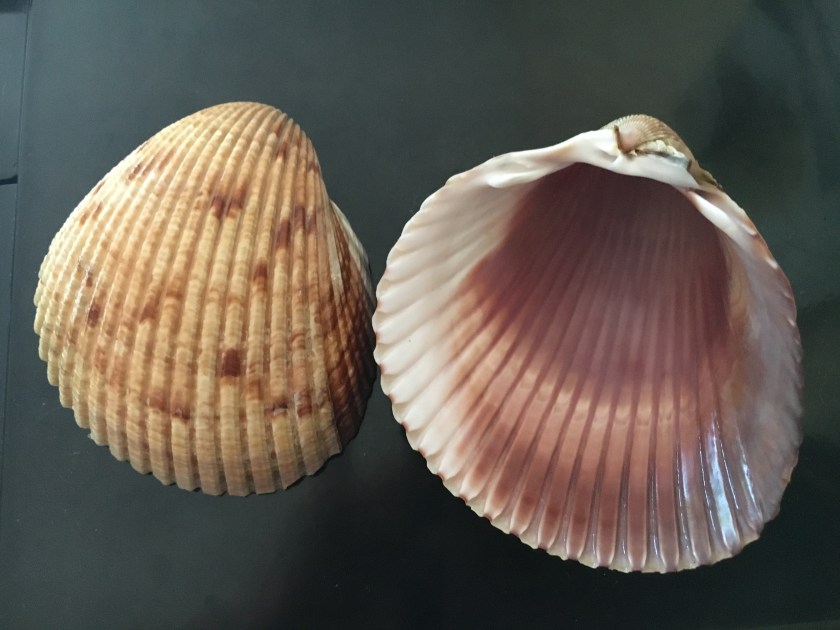
Atlantic Giant Cockle Shell
Once cleaned up, the inside of the giant cockle is mauve pink.
Beautiful coloring on this bivalve
Mussels
Mussel shells are something I rarely collect or photograph because they really are not great looking shells. They are dark colored and shaped like thin fans. The pen shell is distantly related and I have a few pictures here. The pen shell can be nearly a foot in length and is more impressive than a mussel.
We went to the beach for a few hours and I got to visit Ponce Inlet and look for shells. Since my son likes to fish from the beach, he drops me off by the jetty (picture down the page) and drives back down the beach. He’ll park about a mile away so I can travel the inlet beach and then walk to where he is fishing.
This gives me some time alone to beach-comb and then get exercise walking back to the truck. I like to fish, but not at the ocean.
The Dog Beach
The Ponce Inlet beach is also a dog beach. It was not crowded at all, but a few people had their dogs on leashes and were having a nice stroll. You can see the dog and people prints in the sand here. The tide was coming in, but there was still a lot of open beach to explore. I didn’t find many great shells, but did collect a few new scallops, which I love to find.
Ponce de Leon Lighthouse
The Inlet is a wonderful place for photos. Any photographer would get some nice shots here. A few years ago I took a bunch of photos at low tide when the beach was full of ripples and tide pools. They are still some of my favorite pictures.
Rocky Jetty and Surfer’s Beach – Shark Bite Capital
As I left the inlet side of the beach I passed the rocky jetty. To the right of this jetty is the surfing area which is also known as the “shark bite capital of the world”. Surfers can be bitten by the black tip sharks that patrol these waters, but usually it’s a quick bite and they are gone. People rarely, if ever, die but they probably have memorable scars!
I was going to link to a video here, but the NatGeo video is so awful, I didn’t. Many of the images are NOT even from New Smyrna – just something they threw in! Boo on them.
Surfers are the ones that get bitten most often because they look like food to the sharks. Don’t swim where surfing takes place – you shouldn’t do that anyway. There is plenty of beach, so stay further south. Rip currents are a worst threat, so swim near lifeguards.
The high number of shark bites also correlates to the high number of people who visit this area and swim in the ocean.
Young people on the beach watching their friends surf.
The waves were quite large and as I passed by the surfing area, I could see many surfers way out catching waves. My phone camera is not great, but there are a couple of surfers in some of these photos. I think they all fell just as I took the photo… LOL.
Some Things To Know About the Beach
If you plan to drive onto the beach, check the tides. At high tide you won’t be allowed on because the beach will be underwater. Plan to either park in one of the lots (that do cost money), or hit the beach at low tide.
It’s best to have a 4-wheel drive vehicle or you may – yes it’s likely – get stuck in the soft sand when you park. BUT… it’s easy to get help from fellow beachgoers and they will help push you out.
Swim near lifeguards, as there can be rip currents that are unseen.
If a thunderstorm is nearby you will probably be asked to get out of the water and leave the beach – by the beach patrol. Florida’s lightning can be deadly. Don’t travel to the beach on a stormy day, and that means go early in the day during the summer when storms will build all day long and become a problem in the afternoons.
The water temperature was in the high 80’s and this is in October. A few weeks later it had dropped by about ten degrees because the nights (and days) had thankfully cooled off.
A Visit to Flagler Ave and New Smyrna Beach Video
I managed to find a video by a young couple (and their adorable baby) who visited New Smyrna Beach via Flagler Ave., which is where they parked and walked onto the beach. A lot of the video includes their baby, Apollo – almost like a home movie – but the baby is so cute and the couple is very likable. They travel the world and have bunches of videos from their trips. If you are interested, view Chase for Adventure – Visiting the Shark Bite Capital of the World.
Growth in Florida means more high rise condos and hotels and means fewer beach houses in the old Florida style like the one the hurricanes destroyed in 2004.
This post was written after Hurricane Matthew in October 2016. I was in New Smyrna for a closing on my new house, and my son and I took a look at the beach. It was four days…
My trip to Florida was a good one. I had a chance to visit with my son and go out on his boat, but the weather was not the greatest. Although my son had warned me that…