Identifying and Comparing the Cockle Shells

This quest began when I found two pretty, yellowish seashells on a recent beach-combing trip to Ponce Inlet.

yellow prickly cockles and gray shark’s eye shell
Shark’s eye and prickly cockle
yellow pricklycockle gray shell spiral
Yellow prickly cockle and graying whelk spiral

They are shaped a bit like scallops and / or arks but they contain bumps around the sides and bottom of their shells. I knew they were not scallops.

Both new shells (top two in the photo below) were yellow underneath. I also noticed that they had distinct ridges where the shells would have connected. When I looked up these beautiful shells in my identification book, I found that they are both Yellow Pricklycockles.

scallop shells, dosinia, pricklycockles
Top – 2 Pricklycockles, Bottom – 3 scallops

The Yellow Pricklycockle

These shells are a unqiue and rare find for me, but they are not rare shells. According to my reference book, they can be found on beaches all around the state of Florida. Because they look similar to most of the beach bivalves I see, I may very well have passed them over in my beach-combing travels. After all, those ridges would be easy to miss. And the shells I find are not always in great condition.

In the photo below I tried to get a better shot of the ridges on this shell. There are two other types of pricklycockle mentioned in my Seashell ID book and are the “Even” and “Florida” pricklycockle. This yellow type grows to a max of 2.5 inches.

This Shell Got a Brush Cleaning

As I dug through my shells, looking for more cockle shells, I came across this rather ugly, but rough shell. It was a pricklycockle alright, but it was caked with sand and had been hiding in the bottom of my shell dish.

I began to photograph it and decided it really needed a cleaning. Usually I clean off my shells when I get home, but this one somehow got put away dirty. So, I brushed the mud off with a stiff brush and the yellow began to show up!

This is the same shell as in the six photos above! It cleaned up nicely. To my knowledge I now have a total of three yellow pricklycockle shells.

The Atlantic Giant Cockle

Sometimes the underside of bivalves can give better clues as to what type of shell I’m looking at. Often they can look very much alike on the outside.

I noticed that the yellow pricklycockles have distinct protrusions up at the top where the shells attach. When I flipped over the Giant Atlantic cockles in my collection, they had the same unique feature. They are also cockles.

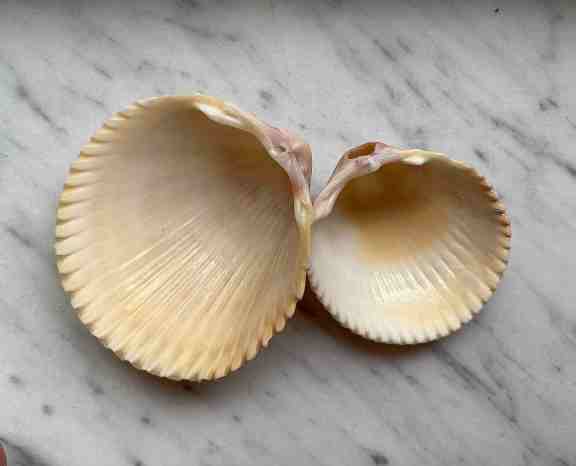
underside of the giant Atlantic cockle shell
The underside of the Atlantic cockle
yellow pricklycockles
See the underside similarities in the cockle shells

I see the big Atlantic cockles quite often and they are usually quite large. Often they are open in the sand where they have most likely been dropped by a predatory shore bird. Usually they are tan in color with splotches of darker brown. The underside can be brown-purple to pretty pink. I always thought they were some kind of clam. Cockles are not clams.

large cockle shells
Giant Atlantic cockles and yellow pricklycockles

I don’t color my photographs when I get them ready to share on this blog. The colors you see here are very close to actual shell colors.

Once I noticed the similarities, I began to dig through my shell collection to see if I had any more unidentified cockles. Turn your bivalves over and it may help with identification.

Digging Through My Seashell Collection

As I began to search through my seashell collection, I got carried away. I began organizing by piling similar shells together. My next venture is to identify the various arks because many of those look a lot alike. I also found a few one-of-a-kind shells which means I rarely find them where I live.

seashell collection
Digging through my collection of shells
yellow pricklycockle shell
The Pricklycockle is the newest addition to my collection

Why I Love to Find a Dosinia Clam Shell

Where I live the white, very flat, dosinia shell is a rare find. On the west / gulf coast of Florida they are more abundant. It’s one reason I love to find them on my beach-combing adventures. Also, they are simply very pretty shells.

The Dosinia below is an Elegant Dosinia, I believe and it was collected from Sanibel Island years ago. The beginnings of a hole on top was probably made by a predatory gastropod of some type. They drill into shells and eat the insides, killing the mollusk.

Dosinia in black and white
Elegant Dosinia

The Differences Between Disc Dosinias and Elegant Dosinias

Dosinias are easy to spot because they are nearly flat, unlike other types of clams which are more sloped. One major difference between the Disc and Elegant dosinia shells is the ridges. Both types contain tightly spaced horizontal ridges, but the Elegant dominica’s ridges are more easily seen. Most of the shells I collect here on the East coast of Florida are disc dosinias. They are very smooth with small ridges – see the shells below.

disc dosinia seashells
Disc Dosinia Seashells

I’ve added more Dosinias to my collection as time goes on. The large white one below was picked up by my youngest son on New Smyrna Beach. He knows I have an interest in shells so he always keeps an eye out for something I may want. I was very excited when he showed it to me.

Dosinia clam shells in all sizes
Dosinia seashells

The smaller shells in my photos were collection on an island near Disappearing Island at Ponce Inlet. I don’t know why, but that area had a large collection of very tiny Dosinias. I think it may have been a hatchery for the mollusk.

Dosinia, jingle shells, Lightning Venus clam
Dosinia, jingle shells (white and black), Lightning Venus clam

Sometimes the Dosinia is found in one piece, with both parts of the bivalve still attached. It’s rare to find a shell like this near rough surf as the waves tend to break shells apart. The Lightning Venus clam in the photo above is a rare find for me as well. I think it’s the only one I have in my collection.

dosinia seashell
A Dosinia in one piece

At least the bivalves cannot be inhabited by hermit crabs so when I find one, I am able to collect it without worry. Since I have quite a few in my collection at this point, I only collect the outstanding Dosinias I find these days.

Below is a collection of shells that include a Dosinia at the bottom with a hole in the shell. Shark’s Eye mollusks are a gastropod that will eat Dosinias. Other clams shown here are arks and a channeled duck clam. Read more about black seashells on my post here, and see shells that are commonly found along the Florida coastline.

Collection of seashells
Black shells: Jingle shell, Ark, Channeled Duck Clam, and also: broken Olive shells, yellow arks, Dosinia shell

Looking For Shells That Are Out of the Ordinary

Because it is March in Florida, the state is overrun with northern visitors and Snow Birds who are here for a few months. Winter vacation brings in the people seeking sun and warmth in the middle of a frigid northern winter.

Bike Week is just winding down, and events are stopping because of the Corona Virus. It’s now so crowded on the roads that I mostly stay home.

But back in February I ventured over to Smyrna Dunes Park and collected a few shells. I was looking for the types of shells I rarely find, and I did luck out.

New shells for my collection

The walk was invigorating near the water as the temperature was in the low 70’s, and with the sea breeze blowing, it was very comfortable. It was late in the day, but the parking lot was still full. Lots of people take their dogs here.

I walked the boardwalk and then headed down to the sand to search for shells that are out of the ordinary for this area.

Right off I found a big, black ark. This is the place to find black seashells. It wasn’t an unusual shell, but it was nice looking.

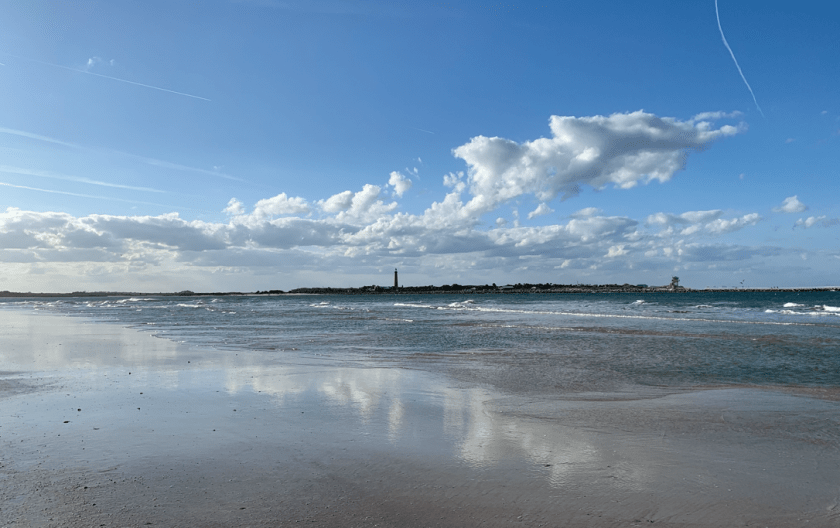
Ponce Inlet New Smyrna Beach Florida
February at Ponce Inlet

As I strolled the shoreline at the inlet and found two golden colored arks with whitish edges. I picked them up. Arks are super common here, but they come in a big variety of colors and can be pretty.

When my son was visiting I found a hairy ark. I assume that is how they look before all that fuzz has been worn off by the waves and sand. I believe this is the periostracum (brown stuff that covers shells) and the clam could be a “bearded ark”, but it’s a guess only.

Ark shell with periostracum covering
Ark shell with periostracum covering making it appear fuzzy

You can see the three arks in my photo below which do not have any brown coating. That is usually how I find them.

The black jingle shell caught my attention because of it’s large size. Jingle shells are not all that common to find around here either. Both black shells are easy to see in the photo below.

seashells black olives
Shells from the Inlet

Then I found my favorite shell, the Dosinia (shell at the bottom on the right in the photo above). As I eyed the sand I saw a flattened shell, and sure enough it was something I wanted.

Other than that, the only other shells I collected were broken bits of Olive shells.

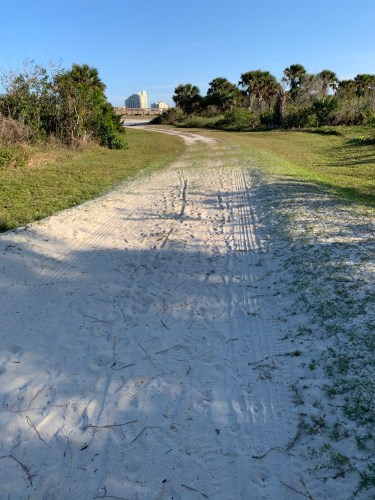
I walked around to the dog beach side of the peninsula and then took the sandy trail leading back to the boardwalk. I’ll share some of my water views and jetty rocks on another post, when I get the photos uploaded.

Ponce Inlet dog trail to beach
Sandy path leading in from the dog beach