Blog

Seashell Identification – Common Atlantic Shells

Some common long shells found on the beaches I frequent are the pen shell, jackknife clam and stout tagelus.

Pen shells often have an iridescent shine and the ones I find are usually just pieces. An unbroken shell can be close to a foot in length.

According to my Seashell Book, there are three types of pen shell: the sawtooth, stiff and half-naked. Pretty weird names. Contrary to what you might think, the sawtooth is the smoothest looking. The other two have vertical ridges going the length of the top “fan” part of the shell.

pen shells
Pen Shells

The Minor Jackknife Clam Shell

This long, whitish shell is the Minor Jackknife clam. My kids used to call it a fingernail shell. It is also a razor clam.

pen shells and jackknife clam shell
Jackknife clam and pen shells

The longish and wider shells shown below next to my eye glasses are stout tagelus. These are also known as “short razor” clams.

stout tagelus clam shell
Stout tagelus clam shells

Pen shells are related to mussels which are not the prettiest of shells. I have one in my photo below along with a tagelus.

Florida seashells
Broken Crown conch, mussel, clam, tagelus, dosinia, little shark’s eye, and tiny marsh periwinkles (one sits on top of a penny).
Ribbed mussel shell
Open and empty mussel shell

Latest from the Blog

Cockle Shells and Ark Shells

Common ark shells found on Florida beaches.

The cockle shell is easy to confuse with the ark shell. Arks are the ones you are most likely to find along Florida’s east coast beaches. Both types live in the sand near beaches, so it figures that their empty shells would be washed up on shore once the mollusk dies.

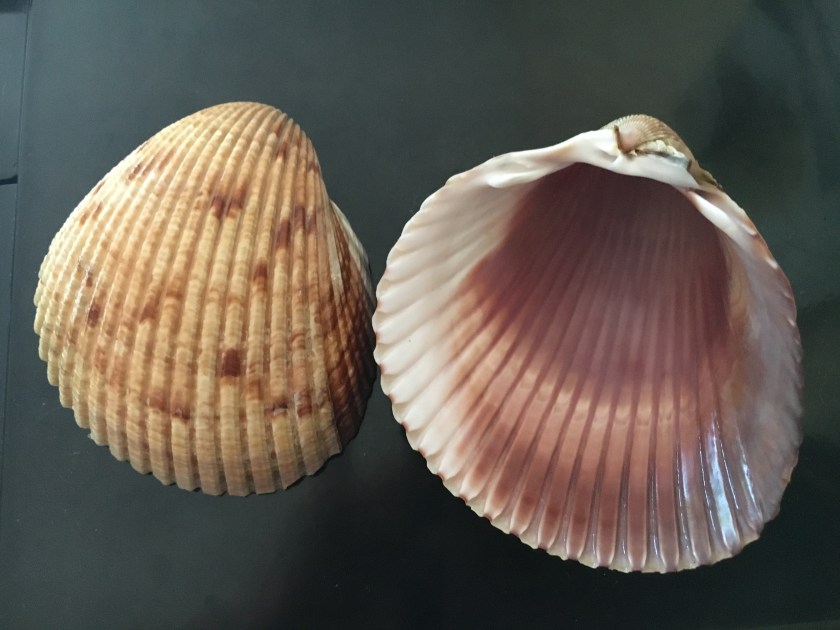
Arks are fairly small in comparison to the Atlantic Giant Cockle, pictured here.  The Giant Cockle can grow to be 5.5 inches.

Inside the giant cockle shell, which is mauve pink in color.
Once cleaned up, the inside of the giant cockle is mauve pink.

The shape of the giant cockle when closed, makes a heart. Therefore, it is also known as the “heart cockle”.
Sorry, my shell is not very pretty, but you can see the heart shape.

heart cockle seashell
The giant cockle is also called the “heart cockle”

Ark shells begin white, and can change color. Shells that are brown, rust color, pinkish and yellow, turn that way from long term exposure to the air. Black shells have darkened because of iron sulfide in the sand in which they are buried.

Arks don’t grow as large as the giant cockle, with their max size being around 4.5 inches (the Cut-ribbed ark), but the ones I find are 1-2 inches.  Within the ark population there are various types of arks, which I will get to later on in this blog.  But all arks can be found on all Florida beaches.

A group of colorful ark seashells in off-white, beige, rust brown, gray and black.
Ark shells can be colorful

Although I find both types of shell often, the larger cockles are usually spotted away from the area of the crashing waves. I find the big ones, usually still hooked together, out on the flats in the backwater areas at low tide.

cockle shells and arks in different sizes and colors
Can you find the 3 cockle shells in this photo?

The arks and cockles resemble each other, unless you look closely. Arks tend to curve a bit at the top. Below I have one of each type side-by-side. They are similar in color and size, but it should be apparent that they are not the same type of shell. Read more about common seashells found on Florida’s east coast.

cockle shell and ark shell side by side to show the different shapes.
Cockle on the left, Ark on the right

About the Chambered Nautilus

The Chambered Nautilus is an interesting mollusk called a cephalopod. Like the squid, octopus and cuttlefish, the nautilus’s head is attached to it’s feet or foot, but unlike them, it has a complete shell to cover it. The shell appears similar to a snail shell, but inside it is divided into “chambers” which hold gas to keep the animal buoyant. He will add water to the inner chambers when he needs to dive deeper and let it out to float. An adult will have about 30 chambers in it’s shell. It is believed that they can live up to 20 years!

Nautilus shell magnet magnet

With very poor eyesight, the nautilus depends on it’s sense of smell to hunt for food. It has a crushing beak which allows it to feed on shrimp and crabs, along with fish, which it catches with it’s 90 (approx.) tentacles, but since it exerts little energy to live and move, it only needs to eat about once a month!
It uses a tube to expel water- jet propulsion- which moves it along to move from place to place. The nautilus will dive deep during the day- to depths of 1800 feet- to avoid predators and rise back up during the night to feed on the reefs.

Nautilus shell section stamp
You will not find a nautilus shell lying on the beach- at least it seems very unlikely- and I do not own one. The photos here came from deegolden’s Store at Zazzle.

They can be found living among coral reefs in the Indian and Pacific Oceans and a full grown nautilus can reach 8 inches in length.

In some places the nautilus population is declining because of the popularity of it’s shell and to save this creature, most of the sites I visited urged consumers to not support the harvesting of the nautilus by purchasing a nautilus shell.

See an online video of a nautilus eating a crab at the National Aquarium in Baltimore by clicking this link.

Read and see more about the Nautilus and it’s shell:
National Aquarium
Seasky.org
Burghley Nef – early (1500’s) ornamental salt holder made with a natutilus shell.

Chambered Nautilus, Palau, Micronesia


Chambered Nautilus, Palau, Micronesia

Photographic Print

Fleetham, David…

24 in. x 32 in.
Buy at AllPosters.com