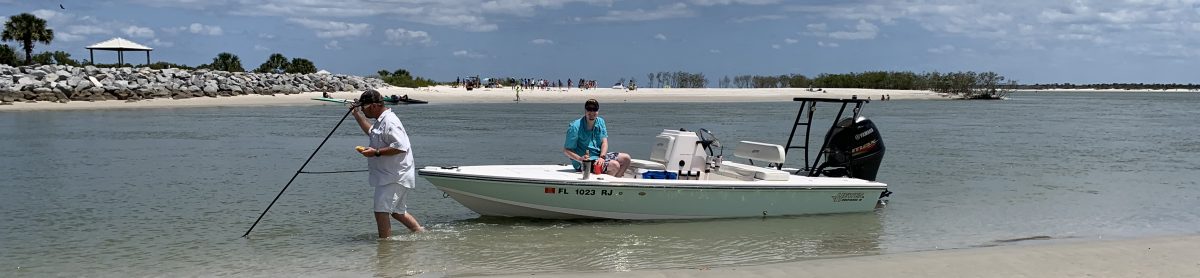
This week my son and I went boating around the river islands. May is a very good time to go boating in Florida. The water temp has warmed to 80 (or close) and the afternoon thunderstorms are not yet a thing.
I try to get a lot of text into most of my posts, but after being out on the boat for two days, I have so many photos to share. All those photos convert to specific posts about my beach-combing finds, but getting the pictures sized and ready also takes time.
Because I end up with many photos of the landscape, like the ones below, I’m sharing a big block of scenes from the Indian River backwater area. Soon I’ll write more in depth about these boating trips because there is a lot to report. For one thing I found more tulip shells in one place than ever before.
Discovered a New Island to Explore
Three Sisters
Some hermit crabs tip their shells up like this crown conch shell in the sand.
The water temp was between 75 and 80 depending on where we went. The first day out we stayed in Edgewater and Oak Hill and found a new, low tide “new island” to explore. I found some really awesome marine life here, which I will be writing about!
Then we headed over to Three Sisters where I found more to photograph. That tiny sea star was a fun discovery!
A new island to explore
After a while my photos all begin to look the same… mud, water, and mangroves! But each area holds wildlife that is interesting and beautiful. I never know what I’ll find out there.
Day Two and Boating North to Ponce Inlet
On our second boating day we headed north to Ponce Inlet to explore the sandy islands left exposed at low tide. It just happened to be a day when a rocket was launched from Cape Canaveral and we could watch.
Unlike our first day of boating, there were more boats and people. Also, there were fewer seashells and lots less marine life. But the water was a beautiful blue and the islands were hard packed sand instead of mud.
While beach-combing at Three Sisters islands I made a fun discovery. This tiny sea star was just lying in the mud, upside-down. He is so small that I had trouble figuring out which was his top and which was his bottom. He is about the size of my fingernail.
The under part of a tiny sea star.
This is exactly how I found him. He was out of the water and turned over. The sun was hot and as I gently moved him, he seemed to be alive. It could have been my imagination, but as I turned him over I think his legs were curling in. He wasn’t hard and brittle.
Found this tiny sea star just like this – upside down in the sand.
I had to assume he was alive, but needed water. The tide had gone out and left him stranded. All Florida starfish live in sandy shallows and can become stranded when the tide goes out, or if waves from a storm wash them ashore. I don’t like to mess with nature, but I’m sure he would have dried out and died if left upside down in the sun.
After getting these photos I took him over to a pool and set him down. I don’t know much about sea stars (or starfish) and never find them out on our island excursions. But, I did find a lined sea star a few months ago. That was my first. This one was so small I nearly overlooked it.
I hope he lived.
It might be time for me to do some research into sea stars. According to my Florida’s Living Beaches book (this is an Amazon affiliate link), none of the typical starfish found around Florida are super common in my area. The only ones mentioned are the Lined Sea Star, Nine-armed sea star, and the Thorny Starfish. This one is obviously not 9-armed, and my guess would be it’s a baby Lined starfish. It doesn’t look like the Thorny variety.
Video of a Thorny Starfish, Naples Florida (West Coast)
The man in the video doesn’t say, but this sea star is a Thorny starfish according to my book. They are more commonly found in south Florida and along the Gulf Coast.
This type of starfish feeds on clams and mussels by suctioning the shell open enough to fit its stomach inside to digest the animal.
Our local park and boat launch area has been closed due to the Covid flu lockdown, but recently re-opened. Of course everyone was anxious to get out… to swim, boat and get fresh air. It was a beautiful day in May and we headed out in our Hewes Redfisher to cruise around.
Enjoying the view from our boat
The tide was super low and still going out when we pulled in behind Three Sisters islands and got out to explore. Water temp was around 80 degrees, and I went for a swim – really a “float” since it was quite shallow. How nice!
The water was very clear, so finding interesting sea life was not difficult. I couldn’t take more than a few steps without coming across moving seashells. Most were inhabited by hermit crabs (as usual), but I found a few with the mollusk inside.
The two little crown conchs in my photo below are showing little black siphons at the end… which means the snail is inside. The University of Florida has an informational page about the Crown Conch.
These crown conch mollusks are alive.
Sometimes the hermits gather in a little group and seem to be examining each other’s shell homes like in my photo below. I was drawn to this gathering because of the color of that small horse conch shell.
Four hermits in various seashells
The brightly colored bivalve I am holding below caught my eye. It was just underwater on the sand and really stood out. This is the Atlantic Giant Cockle and can grow to be very large. It was one of the few shells I collected that day. All the whelks and conchs contained living creatures!
Beautiful coloring on this bivalve
With such a low tide, the “beach” was huge. This is not nice sand, but rather mucky, squishy mud-like stuff. Many creatures were just offshore in the shallow water, but some also drag their shells across the flats, or bury themselves in the mud.
Look at the colors on that crown conch below! Just lovely. I didn’t touch him, as I knew he was alive, just got this photo to show his dark coloring and spiky crown. Once the tide comes back in, all this will be covered in water.
This crown conch is alive and half buried. Love that shell color!
Large lumps in the horizon are always worth checking out. Sometimes it’s just a piece of a tree or clump of seaweed, but it can be something of interest, like this crusty old horse conch! Boy was he covered in stuff….barnacles and oysters were stuck to his shell. To check for life, I nudged the shell and sure enough I knew right away it was inhabited. I could feel the suction, and then I saw a sliver of bright orange (see him at the bottom of the shell in the photo below.)
Horse conch disguised
View my living horse conch post where you can see more of this awesome creature of the sea or take a look at the huge empty horse conch shell a friend found while wading around out here.
I found two super gorgeous Shark’s Eye shells which were not covered in gunk so I could see the coloring. Both had hermits inside, but they were kind enough to allow me some photos. 😉
Shark’s Eye
I hate to have to watermark my photos, but thieves abound. I’ll write anther post showing more photos of these cool round shells. They really are quite amazing.
Spotted Something Under the Water
The most fun I have out on the flats is when I spot something in the water, or on the sand, which is big enough to stand out. In this case it was a big Tulip shell. I’ve found some huge Tulips out here containing huge hermit crabs. And once I found a Giant Red Hermit Crab in this same area. It’s the only one I’ve ever seen.
Spotted a big Tulip shell
Saving the best for last, I want to share this photo of an egg case I found. This is the first time I have seen an egg case on my travels around the flats, beaches and rivers.
When I touched it I found that both ends of the long spiral were buried in the mud. Next to it was this Florida Cerith (containing a tiny hermit crab), so you can see the size comparison.
Egg case!
I know next to nothing about egg cases, but I suspect it was from one of the common whelks or conchs I always see in this area. I didn’t mess with it because it could be full of babies for all I know. The sections looked closed.
We finished up our day of boating with a little fishing (I caught, and released, a big Sail Catfish) and we remarked at how many people were out on the water for a Tuesday!