Plan A Vacation With Good Shelling

Sanibel Island Seashells

The southeastern U. S. coastline, particularly the Gulf coast of Florida, contains some of the best shelling in the world. Sanibel Island and the surrounding area, including Captiva Island are situated just right for “catching” the shells in the current of the Gulf waters and when visiting you’ll find yourself doing the “Sanibel stoop” right along with all the other tourists who are hoping to find the best beach treasures.

When you are tired of shelling on the beaches, take a shelling cruise to the outer islands which are only accessible by boat, where the crowds will be fewer (I assume) and search for more treasures. Taking living shells is NOT ALLOWED – in fact, it’s against the law on Sanibel and in the area.

I’ve never visited the The Baily Matthews Shell Museum on Sanibel Island, – it wasn’t built when I vacationed there and opened in 1995 but every shell collector should find it interesting, and most likely helpful in identifying seashells.  The Museum contains tons of seashells (of course), but also a history of the Calusa Indians and how they used shells in daily life. Here is a listing of exhibits at the museum.

Snorkeling In The Fort Meyers Area

A group of snorkelers observing undersea wildl...
Image via Wikipedia

I just began following another beach person on Twitter and they have a nice write up on places to snorkel in the Ft. Meyers, Sanibel and Captiva Island area.

I have snorkeled once and loved it.  We had taken a cruise without our kids, when we stopped at a port in Cozumel and we took a catamaran out to a spot where we all jumped in and did some snorkeling.  I saw the most beautiful fish and really liked the experience.  I’ve always wanted to do it again, but never have.  Although I lived near the ocean and went to the Atlantic coast often, the water needs to be the crystal blue green like you’ll find in the Caribbean area and it’s not like that off the upper east coast of Florida.  At least, not near the beach.

What I remember is that we had to spit into our face masks to keep them from fogging up.  A handy little trick that I passed on to my kids who liked to snorkel at the ocean and even in the backyard pool.

The Edison Reef is a man made reef, and they all are in that area, created when the Fort Meyers bridge sunk.  I’m trying to recall if that was the bridge that was hit by a ship in the fog one early morning which broke off a large section.   Drivers on their way to work were killed when they unwittingly drove off the end not knowing of the accident.  I know that many years ago there was such a story, I just can’t remember, or find info, telling me which bridge that was.

Anyway, if you go to the area, take along your snorkel gear or book a tour which will include everything you’ll need.

Read more at “Snorkeling in Fort Meyers“.

Cockle Shells and Ark Shells

The cockle shell is easy to confuse with the ark shell. Arks are the ones you are most likely to find along Florida’s east coast beaches. Both types live in the sand near beaches, so it figures that their empty shells would be washed up on shore once the mollusk dies.

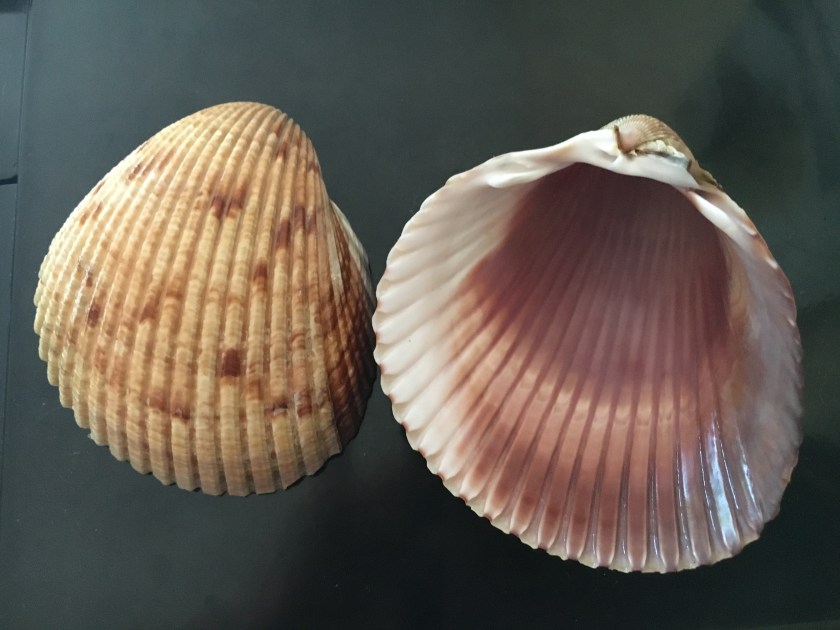
Arks are fairly small in comparison to the Atlantic Giant Cockle, pictured here.  The Giant Cockle can grow to be 5.5 inches.

inside the giant cockle shell
Once cleaned up, the inside of the giant cockle is mauve pink.

The shape of the giant cockle when closed, makes a heart. Therefore, it is also known as the “heart cockle”.
Sorry, my shell is not very pretty, but you can see the heart shape.

heart cockle shell
The giant cockle is also called the “heart cockle”

Ark shells begin white, and can change color. Shells that are brown, rust color, pinkish and yellow, turn that way from long term exposure to the air. Black shells have darkened because of iron sulfide in the sand in which they are buried.

Arks don’t grow as large as the giant cockle, with their max size being around 4.5 inches (the Cut-ribbed ark), but the ones I find are 1-2 inches.  Within the ark population there are various types of arks, which I will get to later on in this blog.  But all arks can be found on all Florida beaches.

ark shells
Ark shells can be colorful

Although I find both types of shell often, the larger cockles are usually spotted away from the area of the crashing waves. I find the big ones, usually still hooked together, out on the flats in the backwater areas at low tide.

cockle shells and arks
Can you find the 3 cockle shells in this photo?

The arks and cockles resemble each other, unless you look closely. Arks tend to curve a bit at the top. Below I have one of each type side-by-side. They are similar in color and size, but it should be apparent that they are not the same type of shell.

cockle shell and ark shell
Cockle on the left, Ark on the right