Whatever You Call Them, Starfish (or Sea Stars) Are Quite Amazing

Crown of Thorns Starfish
Image by quinet via Flickr

Say “starfish” and immediately you probably think, a white creature with five legs. Starfish, or sea stars come in various shapes and sizes and are quite amazing animals. They are very colorful. Starfish are usually white in color only when they have dried up and died.

Beach-combing for starfish would be a unsatisfying hobby. You may dream of finding a beautiful, collectable sea star just lying in the sand, but this is unlikely to happen. Sea stars stay in the water if possible.

The Crown of Thorns sea star is quite an amazing looking creature with spikes all over it (blue star pictured). It is poisonous and dangerous to humans as well as sea life. They eat coral and can be detrimental to coral reefs. They are found in the Indio-Pacific region.

For the most part, starfish don’t harm people.

About Echinoderms

Sea stars are “echinoderms” along with sea urchins, sea cucumbers and sand dollars. They have an exoskeleton and radial symmetry which means that all their legs grow from a central body. They can be found in an array of colors including red and purple and are found in shapes that don’t look anything like you’d expect.

All photos here are courtesy of Pixabay photographers.

The Feather Sea Star

This video is quite amazing. Search for feather sea stars at YouTube to see more feather stars.

The sea star is always found living in salt water. Usually the best place to look for them (to photograph only – no collecting living creatures!) is around rocks and in shallow water. They are nocturnal to avoid predators. This fascinating marine life is even able to regenerate limbs and divide themselves to become two!

Brittle Star – Pixabay image

About Florida Starfish

Florida has three types of starfish: the Lined sea star, the Thorny starfish, and the Nine-legged starfish. (Starfish and sea star are interchangeable here.)

The starfish in the mud is one I photographed while walking the mud flats on the Indian River lagoon at low tide. He was missing parts of two legs and another leg was broken. Read more here.

I don’t have photos to share of the 9-legged, or 9-arm starfish but here is a video that will give a good look at one. They are mainly found in south and west Florida.

The Whelks of Florida

The Whelk shells of Florida are widely collected and they can be some of the largest shells you’ll find on Florida beaches. (Don’t collect them if they are inhabited.)

The Knobbed Whelk (Busycon carica), Channeled Whelk (Busycon canaliculatum), Pear Whelk (Busycon spiratum) and Lightning Whelk (Busycon contrarium) can all be quite large – the Pear is the smallest.  Common characteristics include their long shape with a wide opening down the length of the shell.

Of these four, the Pear Whelk is the smallest when full grown. It grows to a length of 5 1/2 inches. I have come across pear whelks out on the sandy flats while boating. I’ve seen them as yellow, gray and with brown splotches. They are usually inhabited by hermit crabs.  Then I recently found one with a live snail inside. (2nd photo)

pear whelk seashell
Pear whelk seashell with hermit crab inside
pear whelk mollusk
Pear Whelk with Mollusk Inside

The Lightning Whelk is another one I find often in the backwater areas. It’s usually small like the pear whelk, but this one can grow to be 16 inches long.  It is recognizable by it’s left-side opening.

lightning whelk mollusk shell
Live Lightning Whelk (Notice the left-sided opening)

This is a fairly new photo of the knobbed whelk. I discovered it in January just offshore on an island in the Indian River backwater. A hermit crab was living inside, so I got some photos and returned it to the water.

knobbed whelk
Knobbed Whelk

The channeled whelk is not a shell I have found in one piece. It grows to be 7.5 inches in length. The top spiral part of the shell differs from the other whelks because it looks extended, like someone pulled it out. The whorls on the other shells are tight and semi-flat.

large broken whelk shell
White and broken channeled whelk shell remains

This is the only channeled whelk I have found and even though it was very broken it turned out there was a hermit crab living in it! I had to take it back and return it to the water.

The Channeled whelk only lives along the northeastern coast of Florida to about halfway down the state.  I guess that explains why I don’t see many of this kind of shell.

Latest from the Blog

Seashell Identification: How It Began

I am not a seashell expert, just an everyday person who has taken an interest in identifying the Florida shells I have collected over the years.  

This page is about how and why the seashell identification blog began.

The east coast Florida beaches never offered up a lot of shells, but coquinas and arks were regular finds. Of course back when I took my kids to the beach, I didn’t know any shell names. I knew the popular sand dollar and starfish (sea star) but never found those. And I certainly didn’t give much thought to the marine snails that made the shells.

My Early Blog Photos From 2009

When I began working at Zazzle, back in 2007, I used some of my photography to make products to sell. That led to beginning this blog. I began writing from my New Hampshire home and used photos of the shells I had collected over the years.

Believe me, I barely knew what a blog was, and it’s been a learning experience for me. My about page has more info, so I won’t go into my life history, but these days I use the blog for more than writing about seashells. It is now also part of my online stores where I have linked pages at the top menu of this site.

We Bought a Boat!

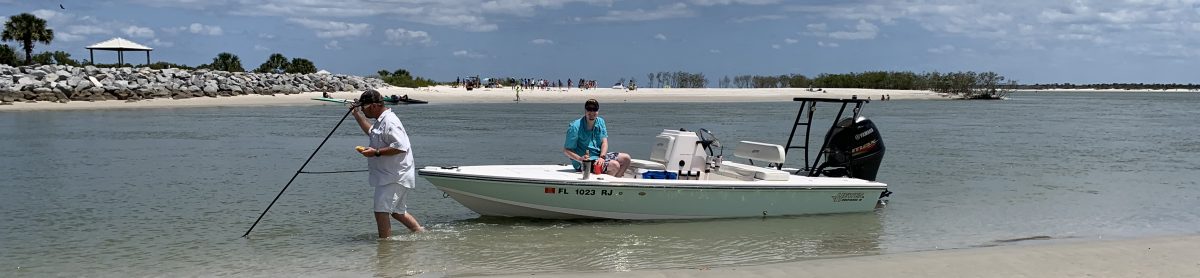
Once I returned to Florida to live, I knew I needed to get away from the crowds by escaping to the water. So, we bought a boat. It’s a Hewes Redfisher flats boat. That may mean nothing to you, but basically it’s a small boat with low sides made for fishing. The draft is shallow so we can go into some quite shallow water. It allows us to travel through the backwaters along the Indian River lagoon area and stop at sandy beaches that show up during low tide.

Now, I can also write about my travels to find shells and sea life because I live in Florida again. Instead of only combing the ocean beach, I can now explore islands along the river. Because they are rarely visited by beachcombers, I find lots to photograph.

Help Identifying Seashells

I began trying to identify all kinds of seashells, but have narrowed it down to the shells of Florida. Some of these shells are also found elsewhere, but the variety is too massive to cover well.

Once I had enough photos, I could create pages to help readers identify common shells they might find while visiting Florida.

I’ve also created free, printable coloring pages for home and homeschool use. I like to think that kids would enjoy learning about marine snails and other sea creatures. See more at the dropdown links at the top of this site.

Some Favorite Island Visits

Here are some truly wonderful and favorite creatures of the sea I encountered while beach-combing.

giant red crab florida
Giant Red Hermit Crab

Spider crab close up
Spider Crab

Every day out on the water is a good one, but sometimes I get lucky and see some unique creatures. The Giant Red Hermit Crab was one such find. I see hermit crabs a lot, but none like this one!

The Spider Crab was another odd creature I encountered while beach-combing in shallow water. Click the photos to read more.

Latest from the Blog

How Important is Our Store zRank in Getting Sales?

Zazzle introduced a Z-rank a few years ago and designers went nuts trying to improve their ranking. The scale goes from 1-10, with ten being the best. I believe that designers hoped that a higher number would bring better sales because Zazzle would somehow prefer the top-ranked stores. Find your store zRank in the backend…