I took this video of a little beach spider back in October during a walk along the beach. At least it looks like a spider. It could be a tiny crab, but it has eight legs that look more like spider than crab.
As I slowly combed the sand for seashells, I noticed this tiny thing crawling toward me. I only got a couple of photos and this short video.
I don’t know what this little guy is, or if he is a baby or adult.
It was a beautiful day for walking, collecting shells, and beach scene photography.
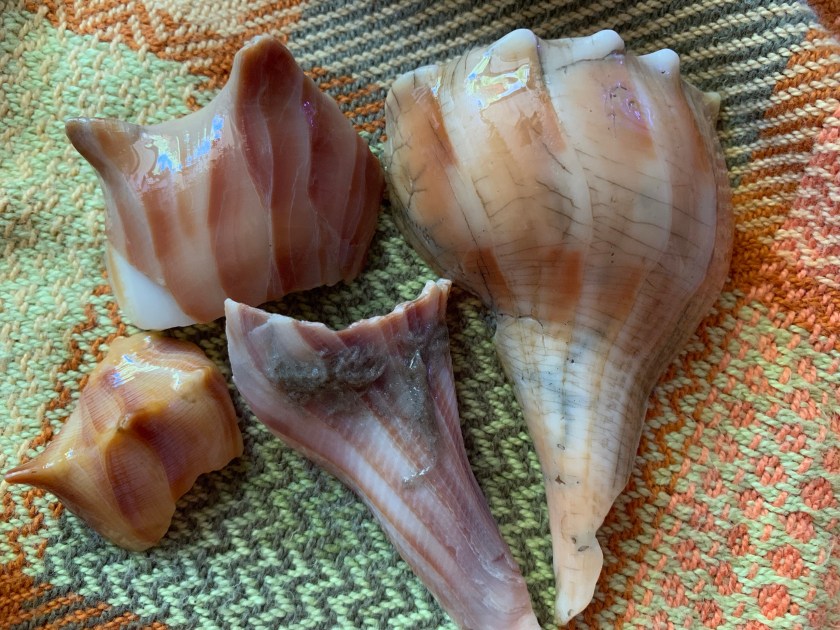
whelks in piecesRinsing shells
See more of my pictures at the beach in October on this post.
It is now January 2022, and we haven’t been boating in a while. We haven’t visited the beach either and it is mainly because the weather is cooler. My son is now my driver, so I only go if he decides to go. The northerners are back and that makes the roads, and everywhere, very packed with people, which for me is a good reason to stay away.
The bivalve seashells, or shells that come in two parts or halves, can be similar in appearance, but not all bivalves are “clams”. I’m not scientifically minded, but I’ve been learning the difference between the shells I collect and photograph.
I’ve gathered some photos of the more common bivalves I see on beaches and in the saltwater rivers around my area of Florida. A general bivalve list includes: clams, oysters, scallops, cockles and mussels.
Clams and Arks
My photos below in this section contain various types of clam shells. Also, there are many types of Venus clams and loads of coquina clams. Shells called “arks” are also clams.
Tagelus clam shell
big clam shell
Ponderous Ark
Transverse Arks (Anadara transversa)
Dosinia clams
Turkey Wing – ark
jackknife clam (with pen shells)
Channeled duckclam
The Spiny Jewel Box is a shell found mostly on the Gulf Coast and possibly the Keys. The Cardita shell is the only one I’ve ever seen and was found on the east coast beaches where I live.
The broad ribbed cardita, measures about an inch in length.
Spiny Jewelbox
Oysters
I rarely collect oyster shells but we see oyster beds while out on our boat. Oyster shells are sharp, and are the scourge of boaters because they can slice up the underside if a bed is accidentally hit while running. While walking the flats in oyster areas I can hear the shells snapping as they feed.
Oyster Shells
Oysters among the mangroves
Oyster bed at low tide
Scallops
Scallop shells can be some of the prettiest shells. Certain types of scallops have one flat side and the other is normal / rounded. The concave part is in the sand or bottom and the flat part is on top and opens like a flap when the scallop is alive. Scallops propel themselves around by opening and closing their shells.
The Kitten Paw and larger Lion’s Paw shells are also scallops. I found these Kitten Paw shells while visiting Sanibel Island on the Gulf coast. I’ve never seen any where I live on the east coast.
2 inches across
Calico Scallops and one Cross-barred venus clam shell
Kitten’s Paw Scallop Shells
Cockles
Cockles are not clams although they look similar. Because they have an oval shape with high top part (umbo), when a whole cockle is viewed from the side it resembles a heart. For that reason, they are known as the heart shell or heart cockle.
Heart cockle
yellow pricklycockles
Yellowish pricklycockle with a piece of a pear whelk turning black
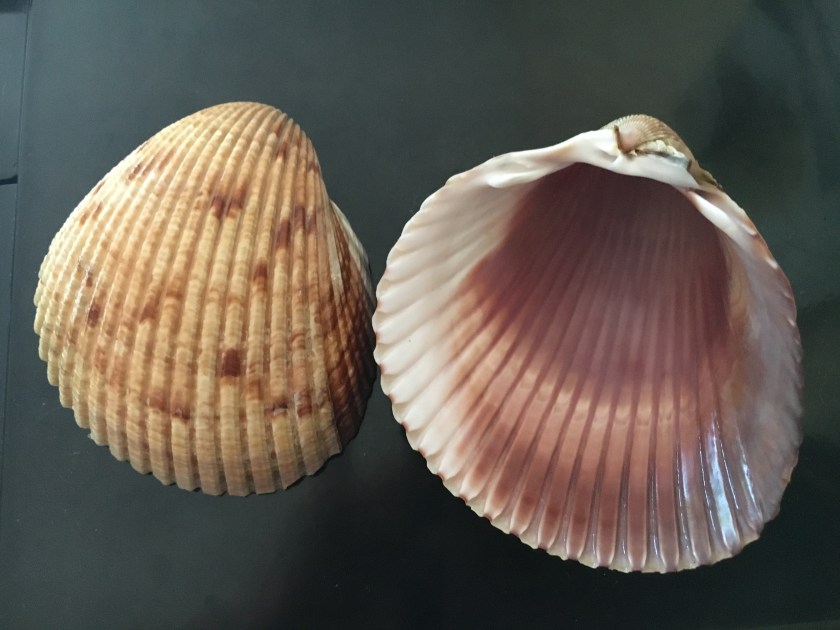
Atlantic Giant Cockle Shell
Once cleaned up, the inside of the giant cockle is mauve pink.
Beautiful coloring on this bivalve
Mussels
Mussel shells are something I rarely collect or photograph because they really are not great looking shells. They are dark colored and shaped like thin fans. The pen shell is distantly related and I have a few pictures here. The pen shell can be nearly a foot in length and is more impressive than a mussel.
While photographing my newly collected shells the other day, I decided to re-photograph my pretty scallop shells. Florida waters can contain a variety of types of scallops, but the shells I find over here on the east coast are mainly the Atlantic Calico Scallop.
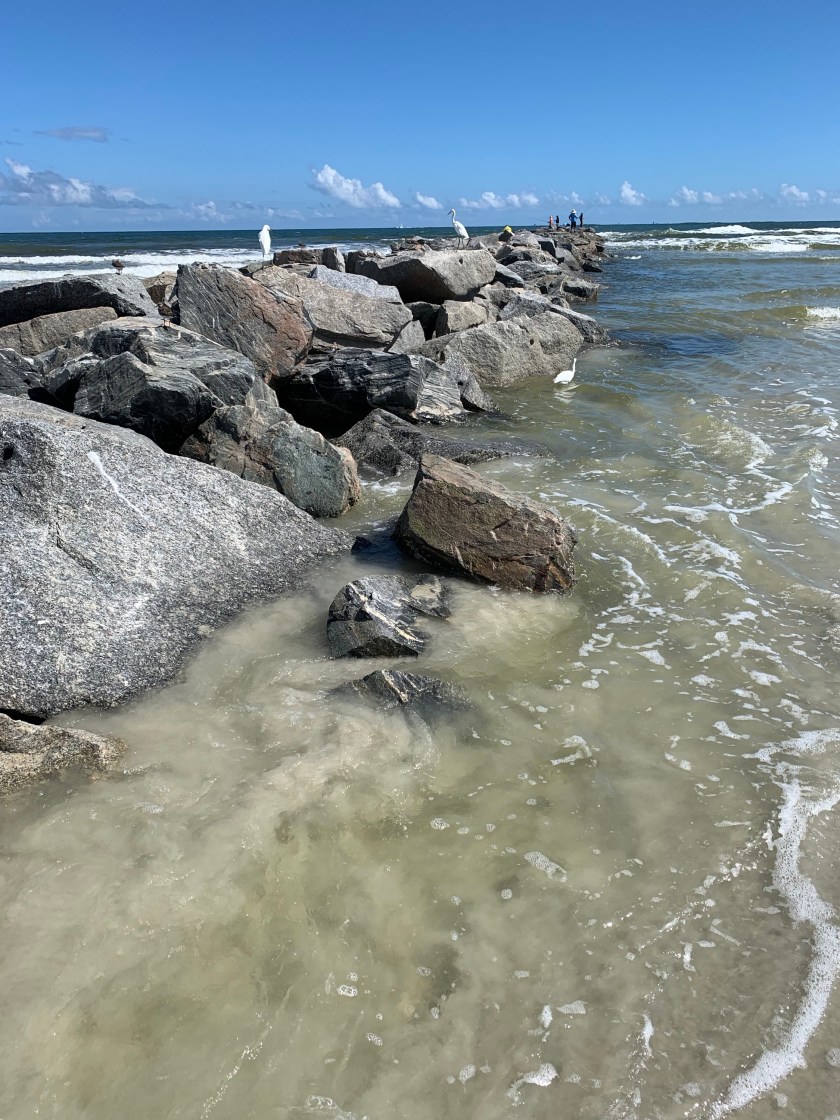
Ponce Inlet, Florida’s central east coast
While beachcombing in my area of Florida, the best shells are often found around Ponce Inlet and the jetty area. Because of the rough surf and strong currents many of the shells are broken, worn, or have turned black. When I say “best shells” I mean the most unusual or rarely seen while I search the sand. I sometimes find olive shells here, big angel wings, scallops, and bits of coral. On this day, I found a pretty little pink scallop and a couple that were blackened from being buried in the sediment for a long time.
Pink and Black Scallop Shells
Jetty rocks and barnaclesRock Jetty at Ponce Inlet in New Smyrna BeachBarnacle and rockRibbed barnacle and jetty rock
Photographing Scallop Shells
Sometimes photos can show a clearer picture of the intricate details of a seashell. The calico scallop, when found before it’s colors fade or turn black or orange, is quite pretty. I have a few of those and you can see the color variety in my photo below. Colors tend to be off-white, cream and yellow with blotches of maroon and pink.
Notice that some of the “ears”, or protrusions at the front of the shell, have worn down or off completely on some shells.
I’ve taken some macro photos to show the ribs on the shells a bit better. Other types of scallops that can be found in Florida waters are the Zig Zag and Round Ribbed, Rough Scallop, Scaly Scallop and famous Lion Paw (very rare). The Bailey-Matthews Museum on Sanibel Island has come good photos Florida’s scallops.
The Round Ribbed and Zig Zag scallop have flat tops so as a bivalve each side looks different. You may find the colorful flat piece or the bottom, less colorful part. The Scaly scallop is more elongated and one of it’s “ears” is much longer than the other.
Bay scallops are now rarely found, according to the Living Beaches book (affiliate link to Amazon, new book version). Their ribs are more squared, but when I look at photos I can’t really see much difference between the Bay and Calico as far as shape. Because the Bay Scallop is now rare, I assume my shells are all Calico varieties.