Did you know that it is possible to find animal paws in the ocean? That’s right, two different shells are named after the paws of animals. Both are a form of scallop shell.
The first one we will talk about is exceptionally large for a scallop. It has all the right stuff to be a beachcomber’s dream find. The coveted lion’s paw shell can be up to 6 inches tall, but sadly it is rarely found in really good condition.
The Lion’s Paw seashell (Nodipecten nodosus) has distinct large ridges that make a bumpy fan shape, and the color of the shell is usually dark orange or dull red, but sometimes it will appear purple or a duller pale color.
This big shell in the center is a faded Lions Paw
The kittenspaw seashell is much easier to find and it is pretty small – only an inch or two wide. I personally have found a few of those (my picture below), but I have never found a Lion’s Paw shell.
This is a picture of my spiny jewelbox seashells. I don’t have many and they are simply call Spiny Jewelbox (Arcinella cornuta). They are white with spikes or ridges (if the spikes have worn down) and the inside is pinkish. These are found on both Florida coasts, but mainly along the Gulf Coast and Keyes area. Many may not have spines because they get broken and worn off by the action of the sea.
This shell is a bi-valve, which means it comes in two parts. It is rare to find any bi-valves that are still attached along the beach because the action of the waves tends to break the shells apart. Also, some bi-valves live attached to something, like wharf pilings or rocks, and that part stays put as the upper half may break off. This is the case when you find a kittenpaw shell.
Other types of Jewelbox shells, which I may have collected at some point when I had no idea what I was picking up, look a bit different than mine. In fact, some do not have spines or spikes, but are still rather bumpy looking. The Leafy Jewelbox (Chama macerophylla) has many flattened, thin ridges (unless they are worn – then they are bumpy) and can be colorful purple and orange or bright yellow.
There is also a Corrugate Jewelbox (or Little Corrugated Jewelbox) which is small, growing only to around one inch in size. It is a flatter, bumpy shell without such distinct ribs as in the spiny variety. Both of these can be collected on most Florida coastlines, although you may have to search harder on the east coast where shells are more sparse. These shells are small, whereas the others can be up to three inches in size.
The Atlantic Left-Handed Jewelbox (Pseudochama radians) is also known as the False Jewelbox and I really don’t know much about that one except that it is found from North Carolina to Brazil.
If you live on the west coast of the U. S., you may find the Clear Jewel Box (Charma arcana) seashell along your coastline. It looks a lot like the Leafy Jewel Box except that it is not as colorful but may be tinged with pink or orange.
What are the spines and “leafy parts” for? It helps protect them from other seashell predators who may want to drill into the shell and eat what is inside. Yup, that’s what they do!
One of my favorite seafoods is scallops. I never used to think much about their shell, until I began to find them along the beach.
The scallop is rounded in shape with protruding flaps at the hinge area (they are bivalves). Sometimes the flaps are similar in size and sometimes one is much larger than the other (Scaly Scallop). Sometimes they are worn and barely visible. Ridges fan out from that front point and can be thin, wide (Lion’s Paw), rough (Rough Scallop), or flat (upper part of the Zig Zag and Rough Ribbed scallops). Sometimes each half of the shell can look entirely different.
Here in Florida there are a few varieties of scallops. Probably the most common type is the Atlantic Calico Scallop (Argopecten gibbus). Shells are colorful in shades of pink and purple with other possible colors like yellow and orange. The entire shell can be colored, or it may have splotches or patterns of color over the shell. This type is what I find on the East coast where I beach-comb. Size is usually around 1-2 inches.
One of the most unique looking scallop is the Kitten’s Paw (Plicatula gibbosa). It’s a tiny shell which is a bit thick and bumpy with more irregular ridges. The ones I have collected came from the Sanibel Island area. They are off-white with orange, or sometimes yellow, coloring with cross-hatch type markings. I have never found one on the East coast of Florida where I live, but my reference book claims this scallop lives all around the state.
Kitten’s Paw Scallop Shells – Max size 1.2 inches
The Atlantic Calico Scallop (Argopecten gibbus) is probably the most commonly found scallop shell in Florida. I’ve collected them on the west coast and east.
Calico Scallops and one Cross-barred venus clam shell
The brightly colored calico scallop shells in my photos above were collected on the West / Gulf coast of Florida. In comparison, the shells in my photo below (Calico shells only) were collected on the East coast. Shells in the Gulf area tend to be more well preserved as they are not churned up in the waves like on the Atlantic side.
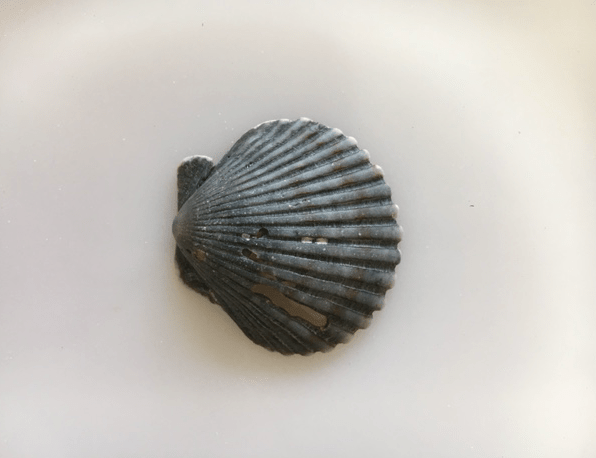
Black Scallop Shell
The black scallop shell was collected from the Ponce Inlet area. I’ve written a post about black shells, because black is not the normal color for seashells.
If you’d like a free, printable coloring page which features the scallop seashell, click here.
Links to Other Types of Scallops Mentioned Here
Atlantic bay scallops (Argopecten irradians) – can be larger than the calico and will reach 4 inches across. They are less colorful than calico also, and will be white, orange or grayish brown. These used to be very common all around Florida and now are not.
Scaly scallops (Caribachlamys sentis) – are small (1.6 inches) and more pointed. Their outstanding characteristic is that one of the front flaps is very large. (The link also shows other types of scallops which I mention in this post.)
Zigzag scallops (Euvola ziczac) – are flat shells (top valve) with colorful zig-zagging colors of purple, pink or orange. They can be up to 4 inches wide. The bottom part of the shell is rounded like a regular shell. (See a good photo in that link.)
Round-rib scallops – look similar to the Zigzag and also flat, but their ribs are wider. They are smaller than the Zigzag at max 2 inches.
Rough scallops – This type is rarely found on beaches. Usually they are solid colored and only grow to 1.5 inches. They have rough ribs, with tiny bumps, hence the name.
The coveted Lion’s Paw is a scallop shell with extra wide ridges. It is not commonly found anywhere here in Florida, but it is possible to find one. Your best chance of finding a Lion’s Paw would probably be over by Sanibel Island on the Gulf.
A couple of helpful ideas for keeping the camper in shape. While traveling, the fridge needs to stay shut! And, we cover our couch when the cats come along.
If you like to camp in a tent in Florida, we’ve seen some nice spots at campgrounds we visit. Here is a short list of what we’ve found for shaded, tent camping.