The Left-Handed Seashell is the Florida Lightning Whelk

Pictures and information about the lightning whelk marine snail which is a rarely found sinistral shell.

One pretty seashell you may find if vacationing along coast of Florida is the lightning whelk (Busycon contrarium).

It is commonly found along the southern United States beaches from the Carolinas to Texas, and is the state shell of Texas.

The Rare Sinistral Seashell

The shell is easily  recognizable by the tan or gray color with darker stripes and the fact that the opening is on the left side of the shell.  It is one of the only gastropods (shells in one piece) to have this unique, sinistral aperture feature.

The lightning whelk lives in shallow, sandy areas and prefers warm water.  This makes Florida the perfect location to call home.

It may be easier to collect an empty lightning whelk shell while visiting the gulf coast area.  This is because Sanibel Island, located on the west coast, is known as one of the best shelling places in the world.  But the lightning whelk can also be found on the East Coast.  You may have to travel away from the ocean seashore to find one.  The inner waterway / rivers are where I’ve found it.

I’ve come across lightning whelks on islands along the Intracoastal waterway.  While boating and fishing, I usually get out and explore the muddy flats when the tide is low.  This is an excellent time to find living sea life.  Usually the shells are inhabited either by the mollusk or a hermit crab.

Live Lightning Whelk Snails

Below are a couple of photos of one such shell I found while walking the flats.  This whelk had a pretty white top while the rest of the shell was more dark gray.  I would have loved to collect it, but as you can see, the little guy who created that beautiful specimen was still using it as his home.

That yellowish hard piece is the operculum, or trapdoor, which shuts the snail inside the shell.  It is made to fit perfectly within the aperture so no fleshy parts are exposed.

Screen Shot 2017-07-21 at 4.30.02 PM
lightning whelk shell
Living Lightning Whelk

I always bring my camera because most of the shells I find offshore while boating contain living creatures.  I seldom find anything but worn, broken shells to bring home.

The Pear Whelk is a Similar Looking Shell

A similar looking shell that I also find is the pear whelk.  It has a very similar shape, but it’s opening is on the right, like most gastropod shells.  So far, every one I’ve found has been home to a hermit crab, but I always take photos.

All the shells below are not lighting whelks, but pear whelks. They do not get as large.

Although the lightning whelk can grow to be very large, there is one that is even larger.  The Florida horse conch can have the lightning whelk for dinner!

So what is the difference between a whelk and a conch?  I intend to answer that soon.

Help yourself to this free printout of a lightning whelk shell outline.

lightning whelk sea shell
Lightning whelk
Florida lightning whelk coloring page
Lightning whelk

Collecting the Popular Scallop Seashell

One of my favorite seafoods is scallops.  I never used to think much about their shell, until I began to find them along the beach.

The scallop is rounded in shape with protruding flaps at the hinge area (they are bivalves).  Sometimes the flaps are similar in size and sometimes one is much larger than the other (Scaly Scallop). Sometimes they are worn and barely visible.  Ridges fan out from that front point and can be thin, wide (Lion’s Paw), rough (Rough Scallop), or flat (upper part of the Zig Zag and Rough Ribbed scallops).  Sometimes each half of the shell can look entirely different.

Here in Florida there are a few varieties of scallops.  Probably the most common type is the Atlantic Calico Scallop (Argopecten gibbus).  Shells are colorful in shades of pink and purple with other possible colors like yellow and orange.  The entire shell can be colored, or it may have splotches or patterns of color over the shell.  This type is what I find on the East coast where I beach-comb. Size is usually around 1-2 inches.

One of the most unique looking scallop is the Kitten’s Paw (Plicatula gibbosa).  It’s a tiny shell which is a bit thick and bumpy with more irregular ridges.  The ones I have collected came from the Sanibel Island area.  They are off-white with orange, or sometimes yellow, coloring with cross-hatch type markings.  I have never found one on the East coast of Florida where I live, but my reference book claims this scallop lives all around the state.

kitten paw seashells
Kitten’s Paw Scallop Shells – Max size 1.2 inches

The Atlantic Calico Scallop (Argopecten gibbus) is probably the most commonly found scallop shell in Florida. I’ve collected them on the west coast and east.

scallop shells
Calico Scallops and one Cross-barred venus clam shell

The brightly colored calico scallop shells in my photos above were collected on the West / Gulf coast of Florida. In comparison, the shells in my photo below (Calico shells only) were collected on the East coast. Shells in the Gulf area tend to be more well preserved as they are not churned up in the waves like on the Atlantic side.

black scallop shell
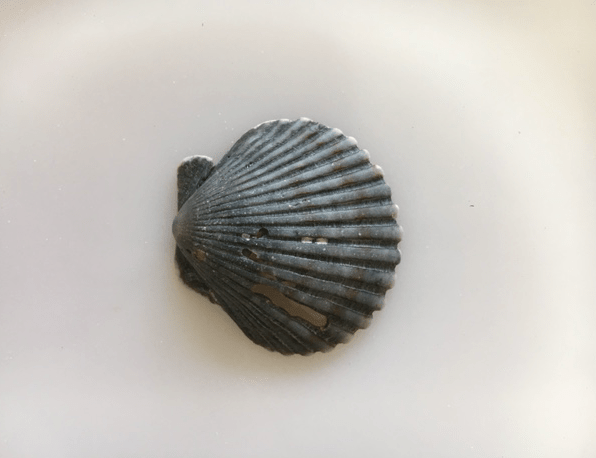
Black Scallop Shell

The black scallop shell was collected from the Ponce Inlet area. I’ve written a post about black shells, because black is not the normal color for seashells.

If you’d like a free, printable coloring page which features the scallop seashell, click here.

Links to Other Types of Scallops Mentioned Here


  • Atlantic bay scallops (Argopecten irradians) – can be larger than the calico and will reach 4 inches across.  They are less colorful than calico also, and will be white, orange or grayish brown.  These used to be very common all around Florida and now are not.
  • Scaly scallops (Caribachlamys sentis) – are small (1.6 inches) and more pointed.  Their outstanding characteristic is that one of the front flaps is very large.  (The link also shows other types of scallops which I mention in this post.)
  • Zigzag scallops (Euvola ziczac) – are flat shells (top valve) with colorful zig-zagging colors of purple, pink or orange. They can be up to 4 inches wide.  The bottom part of the shell is rounded like a regular shell. (See a good photo in that link.)
  • Round-rib scallops – look similar to the Zigzag and also flat, but their ribs are wider. They are smaller than the Zigzag at max 2 inches.
  • Rough scallops – This type is rarely found on beaches. Usually they are solid colored and only grow to 1.5 inches. They have rough ribs, with tiny bumps, hence the name.
  • The coveted Lion’s Paw is a scallop shell with extra wide ridges.  It is not commonly found anywhere here in Florida, but it is possible to find one.  Your best chance of finding a Lion’s Paw would probably be over by Sanibel Island on the Gulf.

Latest from the Blog

Tent Camping in Florida

If you like to camp in a tent in Florida, we’ve seen some nice spots at campgrounds we visit. Here is a short list of what we’ve found for shaded, tent camping.

Please Accept My Apology

I apologize for the bad way my blog is behaving. I am fixing things and appreciate my readers.

Shells in Sun Will Fade

Pink conch shell on porch railing
Pink or Queen Conch Shell

The beautiful coloring of shells won’t last forever and especially if you put them outdoors in the sun.  I have learned this the hard way!

I bought a couple of large pink conchs about 20 years ago (I no longer buy seashells) and I’ve been putting them on my sunny porch railing in summer.  Lately I’ve noticed that they are looking more faded and not quite so pink and it’s because of the sun!  Mollusks spend their time living down in the water, out of the sun so it stands to reason that shells are not made to withstand sunshine.

On the other hand, if your starfish or sand dollars need brightening, just set them out in the sun for a while.  They are much more brittle than a sea shell and be sure to bring them in when it rains because water will make them soft.