Scallop Shells Collected on the East Coast

While photographing my newly collected shells the other day, I decided to re-photograph my pretty scallop shells. Florida waters can contain a variety of types of scallops, but the shells I find over here on the east coast are mainly the Atlantic Calico Scallop.

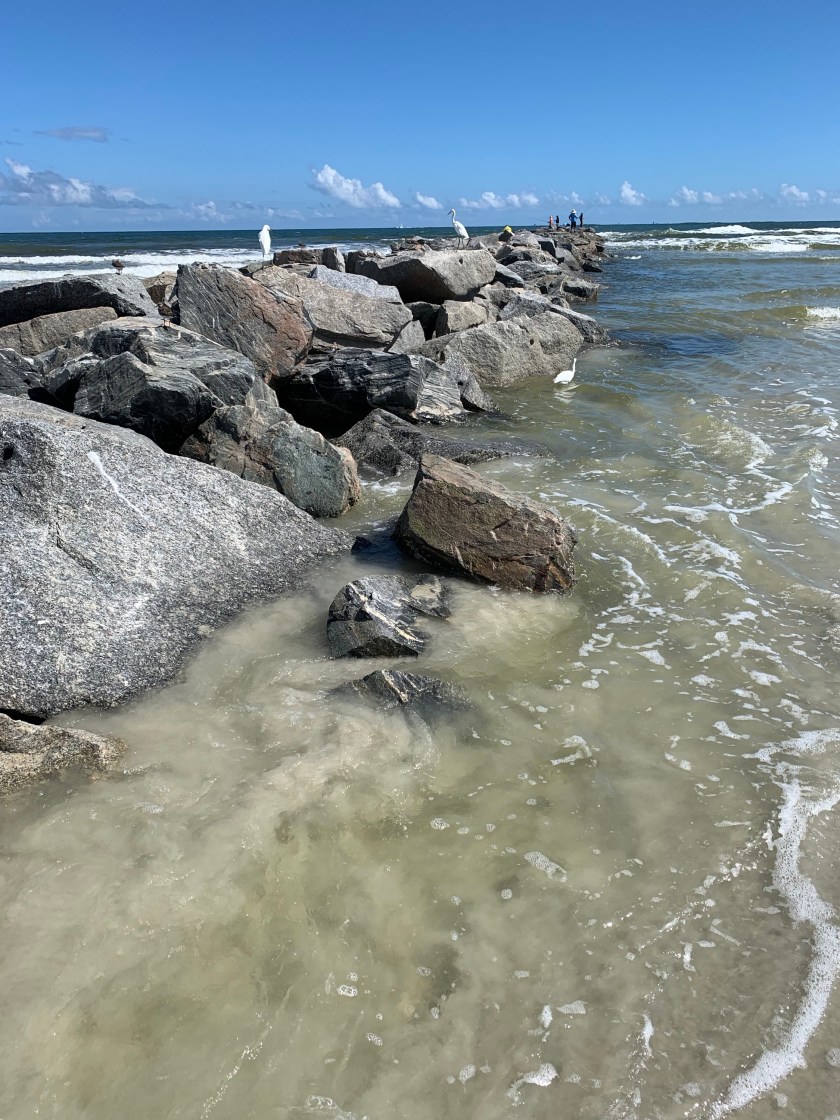
Ponce Inlet, Florida’s central east coast

While beachcombing in my area of Florida, the best shells are often found around Ponce Inlet and the jetty area. Because of the rough surf and strong currents many of the shells are broken, worn, or have turned black. When I say “best shells” I mean the most unusual or rarely seen while I search the sand. I sometimes find olive shells here, big angel wings, scallops, and bits of coral. On this day, I found a pretty little pink scallop and a couple that were blackened from being buried in the sediment for a long time.

Pink and Black Scallop Shells

Photographing Scallop Shells

Sometimes photos can show a clearer picture of the intricate details of a seashell. The calico scallop, when found before it’s colors fade or turn black or orange, is quite pretty. I have a few of those and you can see the color variety in my photo below. Colors tend to be off-white, cream and yellow with blotches of maroon and pink.

Notice that some of the “ears”, or protrusions at the front of the shell, have worn down or off completely on some shells.

calico scallops

I’ve taken some macro photos to show the ribs on the shells a bit better. Other types of scallops that can be found in Florida waters are the Zig Zag and Round Ribbed, Rough Scallop, Scaly Scallop and famous Lion Paw (very rare). The Bailey-Matthews Museum on Sanibel Island has come good photos Florida’s scallops.

The Round Ribbed and Zig Zag scallop have flat tops so as a bivalve each side looks different. You may find the colorful flat piece or the bottom, less colorful part. The Scaly scallop is more elongated and one of it’s “ears” is much longer than the other.

Bay scallops are now rarely found, according to the Living Beaches book (affiliate link to Amazon, new book version). Their ribs are more squared, but when I look at photos I can’t really see much difference between the Bay and Calico as far as shape. Because the Bay Scallop is now rare, I assume my shells are all Calico varieties.

Early Boating Day to Beat the Thunderheads

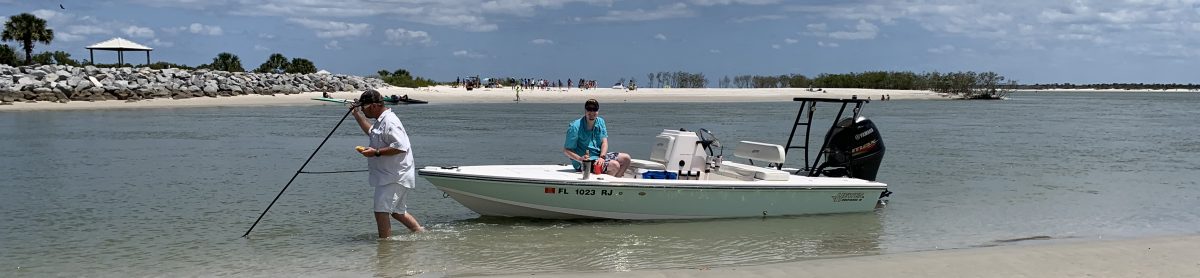
We’ve been getting rain like a monsoon lately but finally we got in an early day of boating to beat the thunderheads. We were on the water by ten in the morning, which is early for us. My son is not an early riser. With the chance of rain nearly always possible, we hoped to get a few hours in.

After riding around for a bit my son dropped me at an island beach while he went across the river to fish.

island view
The Island

Today the place was deserted. It was a Thursday so not surprising. I walked the beach looking for treasure in the form of seashells but found nothing – except for the one broken and partially buried shell right in front of the boat landing.

broken knobbed whelk treasure buried in the sand
Broken knobbed whelk shell

Most people would probably pass on collecting this shell, but I rarely find shells this size, even if they are broken. I’ve never found a live knobbed whelk snail. In fact, knobbed whelk shells are not common in this area.

This marine snail makes a beautiful shell, and I found a stunning one a while ago just off this very island, in roughly the same place. It contained a big hermit crab, but I got some photos before putting it back into the water. That shell was tan in color with a shiny exterior. It is still one of my favorite finds.

The knobbed whelk is a hefty shell so this one had done a lot of rolling around in the water to break it up or possibly it was broken by a boat. Boats often pull up to this island. There was absolutely no place for a hermit crab to hide inside. I brought it home and cleaned it up.

The tide was going out but the water was very murky and brown. It was not at all inviting. The beach held no other treasures so I texted my son and he came back to pick me up and we moved on.

Encrusted Horse Conch

We headed into a little bay area that has a lot of shallow spots. I was looking for a place to get out and dip into the 83 degree water to cool off a bit. We pulled up to this little beach area.

Little beach
Little beach where I found the horse conch shell

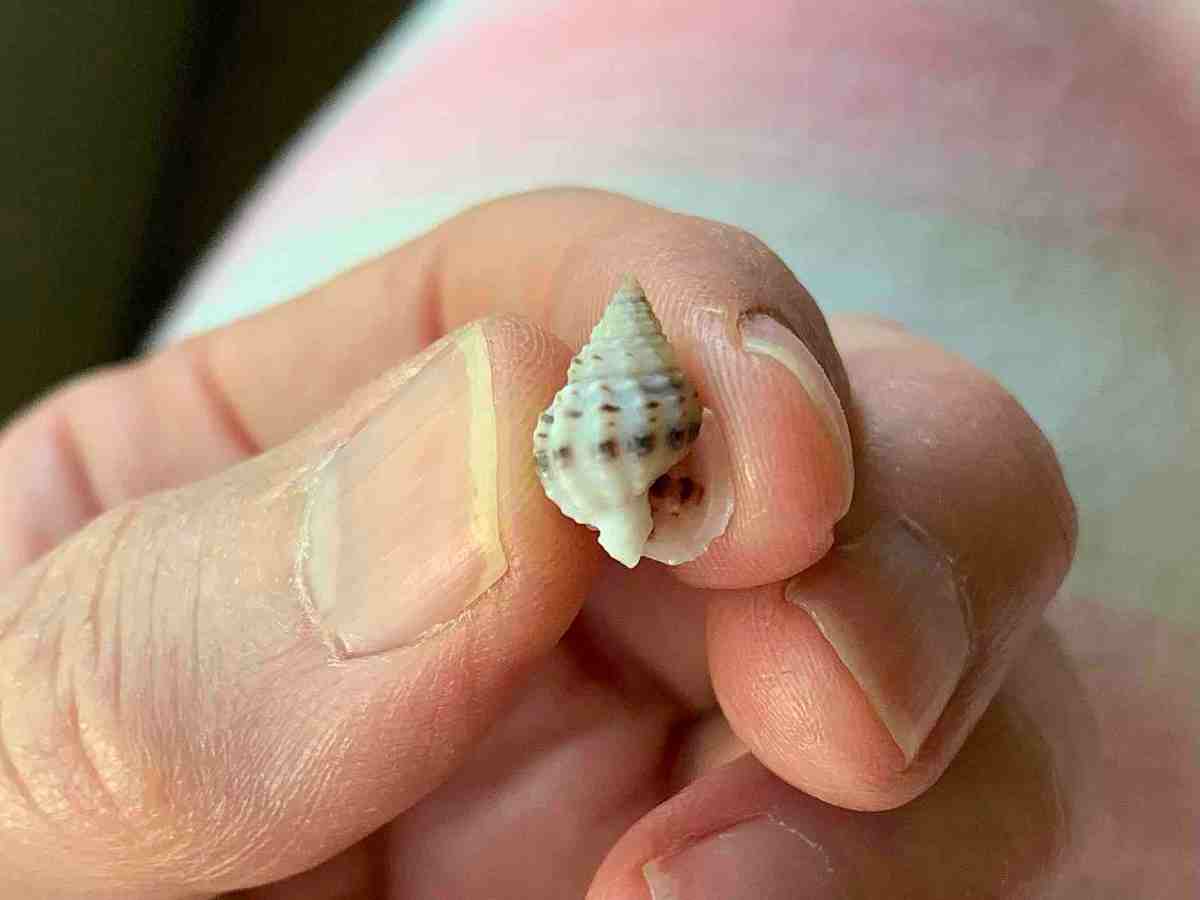
I hopped off the boat here only to see a nice size, yet juvenile, horse conch shell moving along the bottom. I t had a hermit crab inside, but I got some photos of this beauty. The sand was very soft and sucked at my feet, so not a good place to take a dip. We moved on into Oyster Bay.

Into the Bay

Heading a little further into the backwaters there is a big shallow area. Here the water was only a foot or two deep. We were able to get out and float while keeping hold of the boat so it didn’t drift away. As I mentioned the water was pretty brown and I mostly worry about stingrays.

shallow area where we got out to swim

I think this area of the lagoon is called Oyster Bay because it is very shallow with lots of oyster beds. Oyster shells are very sharp and can harm boats. It’s also easy to get a fishing line caught on the shells, so we don’t go in here much. I did find a huge, living horse conch in this area one time.

We’d been keeping an eye on the sky all day because the line of clouds over land and over the ocean could build and move in our direction.

Keeping an Eye on The Clouds

We made it in before the storm reached us, but you never know. Florida storms can have lots of lightning so we don’t take any chances. We had a good four hours out on the water, which was nice.

Sea Life Specimens Under Glass

Starfish, sea urchins, and shells collected and preserved under glass at Smyrna Dunes Park.

At Smyrna Dunes Park in New Smyrna Beach there is a display of sea life specimens under glass. At the pavilion by the parking area this case of seashells, sea urchins, sand dollars and sea stars (starfish) can be found near the public bathrooms.

The photos aren’t very good because of glare, but I thought it would be fun to share the variety of sea life here on my blog. Many shells in this collection are very familiar to me, and others I have never found.

I’ve printed the names of most items on the photo below so they can be read easier. At the top to the far left are the olive shells, and on the far right are oysters.

On my travels to beaches at the ocean and along the river I have never found the following: Scotch bonnet, paper fig, nutmeg shell and murex.

This collection is probably meant to represent the entire state and not only what is found near this park. They also have a Paper Nautilus which I’ve never even heard of. (See it in the center below, just beneath the Baby’s Ear.)

Sea life collection under glass
Seashell and sea life Identification

Most often I find arks / clams, shark’s eye (moonsnail), crown conch, horse conch, lightning whelk, pear whelk (I forgot to print it, but they are next to the Paper Fig), slipper shells (above the lightning whelks) and jingle shells. See my gallery slide show below.

I’m less likely to see olives and tulips. I’ve only found pieces of sand dollars, but a nice lady once gave me a whole sand dollar while I was walking the beach. I have never found a starfish or sea urchin.

My Seashell Photos

Shells (and live snails) I’ve photographed on my beach-combing travels. Only empty shells are collected and most gastropods I find are either alive, with the snail inside, or have a hermit crab residing.

I have a round, flat bowl full of my favorite shell finds, so these days I rarely take shells home unless they really stand out as unusual. Recently I picked up two yellow pricklycockles to add to the collection.

  • crown conch
  • tulip shell with barnacles
  • fighting conch
  • Lightning whelks and pear whelks
  • black and silver jingle shells
  • lettered olive shells
  • Beautiful sharks eye moon shell
  • Smaller horse conch seashell found in the mud
  • white baby’s ear shell
  • Slipper shells orange and black